.svg)
.svg)
 For Instructor
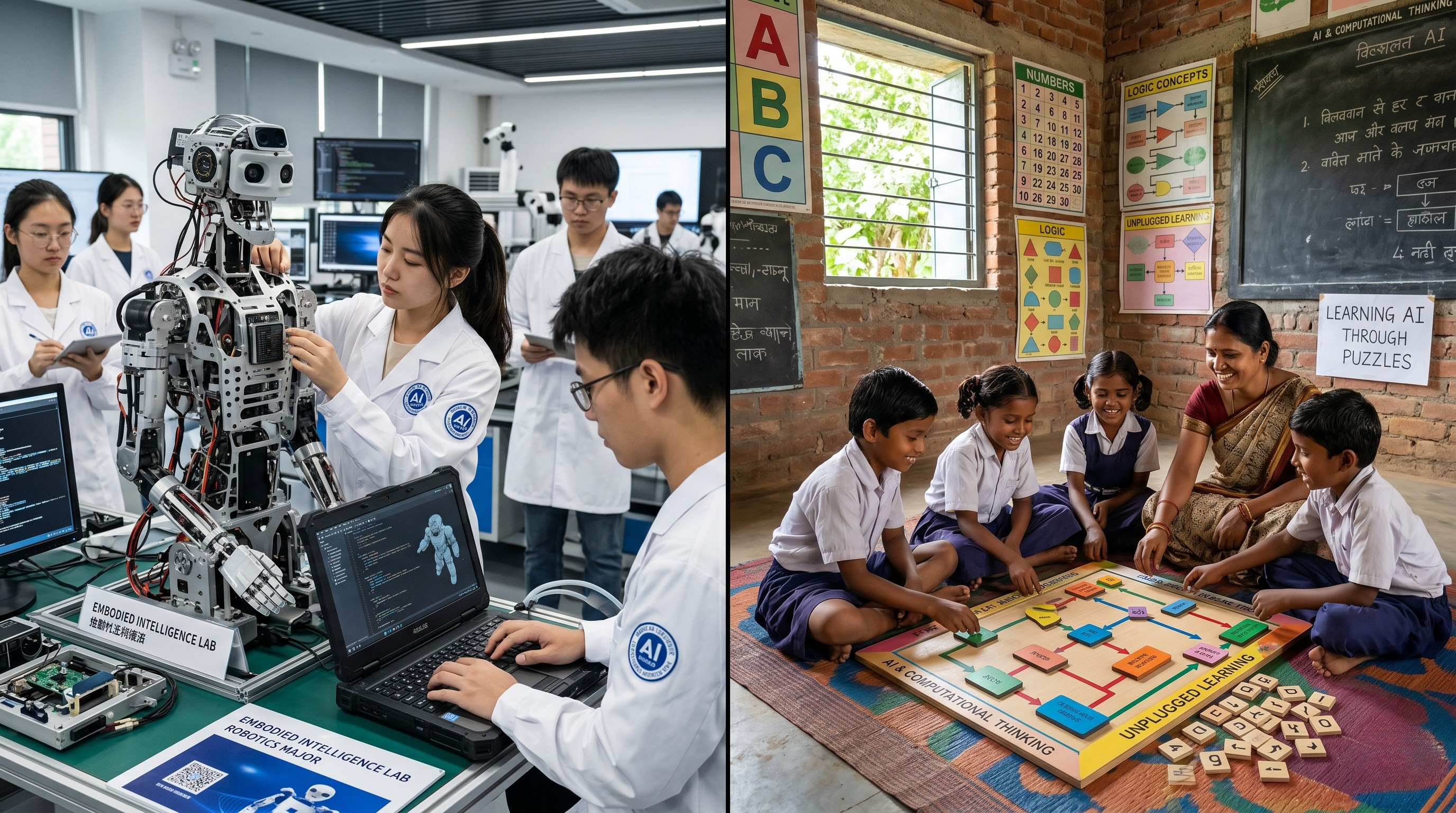
How would you feel if one day you woke up and realized your whole country had completely overhauled its entire system of higher education? This is what China has done over the past 5 years. The level of this transformation is unlike anything else attempted ex-chemically on any other nation before — when China discreetly eliminated 12,000+ “traditional” university degrees.
Degrees in the arts and humanities, foreign languages, and business management are disappearing. They are being replaced with an entirely new set of degree programs. In total, over 10,000 new degree programs focused entirely on artificial intelligence, robotics, and other technology/technology advancements will be available in China.
Among these new degree programs is a degree that appears to have come from the pages of a sci-fi novel: “Embodied Intelligence”.
Beginning in 2021, instead of just learning how to code or develop language models, Chinese students will be learning how to design, build & program real, physical robots capable of learning, thinking and acting on their own in the real world - with 9 leading universities already offering this degree and establishing a dramatic shift in educational focus.
Consider the nature of this change on such a scale. Over a five-year period, more than thirty percent of the entirety of China’s college system has been completely restructured. This is not merely an update to curricula or the introduction of a few new electives, but a complete restructuring of how talent is developed from the ground up. China surveyed the global economy, recognized where the world was heading, then aggressively redesigned their education system to provide the types and quantities of graduates necessary to meet that demand.
Their goal is to address a major, immediate supply issue. They also recognize that there are not enough highly-skilled technical workers in the workforce to support the sort of economy they are building today, which is based on automated manufacturing, advanced robotics, and AI-enabled infrastructure. They have made such a dramatic shift to their universities with the intention of producing graduates in large numbers with similar capabilities that are needed in order to maintain their manufacturing superiority.
At the Same Time India Plays a Different Game
While everyone else is focusing on the transformation of Chinese universities and institutions; very few have noticed that right outside China; India took an equally large gamble with Artificial Intelligence (AI) as well—except, rather than beginning with 18-year-old college freshman, India started with 8-year-olds.
Accordingly, beginning in 2026, students in India will be required to learn about and understand AI and computational thinking from grade three onward (level 3). This is a significant change in the way foundational education has traditionally been taught. Now an 8 year old child in a small rural village in India will understand the basic concepts of AI long before they make their first college choice or career decision.
Things are going to get pretty interesting (and frankly difficult) from there. The realities of India's current educational system are that half the schools in India do not have adequate digital infrastructure. Most of the current schools in India do not have enough computers, sufficient high-speed internet access, or tablets to effectively teach every student. So how do you successfully teach cutting edge computational thinking to a third grader who doesn’t even have a screen?
The Indian government's approach is not only highly imaginative but also very practical in that they are creating ways to train people to be able to perform AI-related functions without using computers.
All of the educators involved in this project will use physical puzzles, fun activities, and structured group work to develop the same logical reasoning and problem-solving abilities that are required to program with a computer so that they can develop (and support) students' understanding of algorithms, sorting data, etc., in an entirely unplugged manner. It is an innovative way to ensure that the absence of hardware will not be an impediment to producing minds that will be ready to produce new software.
The level of ambition is clearly substantial. Although it will take a significant amount of time, and there will be multiple logistical challenges to overcome along the way, we must all take some time to really consider just how important this project is and what it represents for the future of education.
Comparison of Supply and Readiness: Two Strategies for the Future
If you look at these two major projects from a different perspective, you can see how each has developed dramatically contrasting strategies and philosophies regarding the future of the world.
China is primarily concerned with the "now" and the "immediate" next. As a country with numerous factories, technology firms and supply chains, but with a desperate need for uniquely qualified engineers to run them, China has implemented a mandatory top-down policy for universities in order to produce many engineers at once and to some extent they have exchanged comprehensive and general education for highly specific and immediately useful education.
On the other side of the globe, India is attempting to address a different type of problem. India is not simply trying to fill open positions that currently exist but to educate a primarily young, yet-to-be-working population to prepare itself for jobs that have not yet been invented. By starting to implement computational thinking in children under 10 years of age, India has categorized literacy in artificial intelligence as it would traditional literacy (reading and writing), but unlike literacy in traditional languages, literacy in AI is no longer considered to be limited to engineers and will eventually be a basic form of communication for individuals worldwide.