.svg)
.svg)
 For Instructor
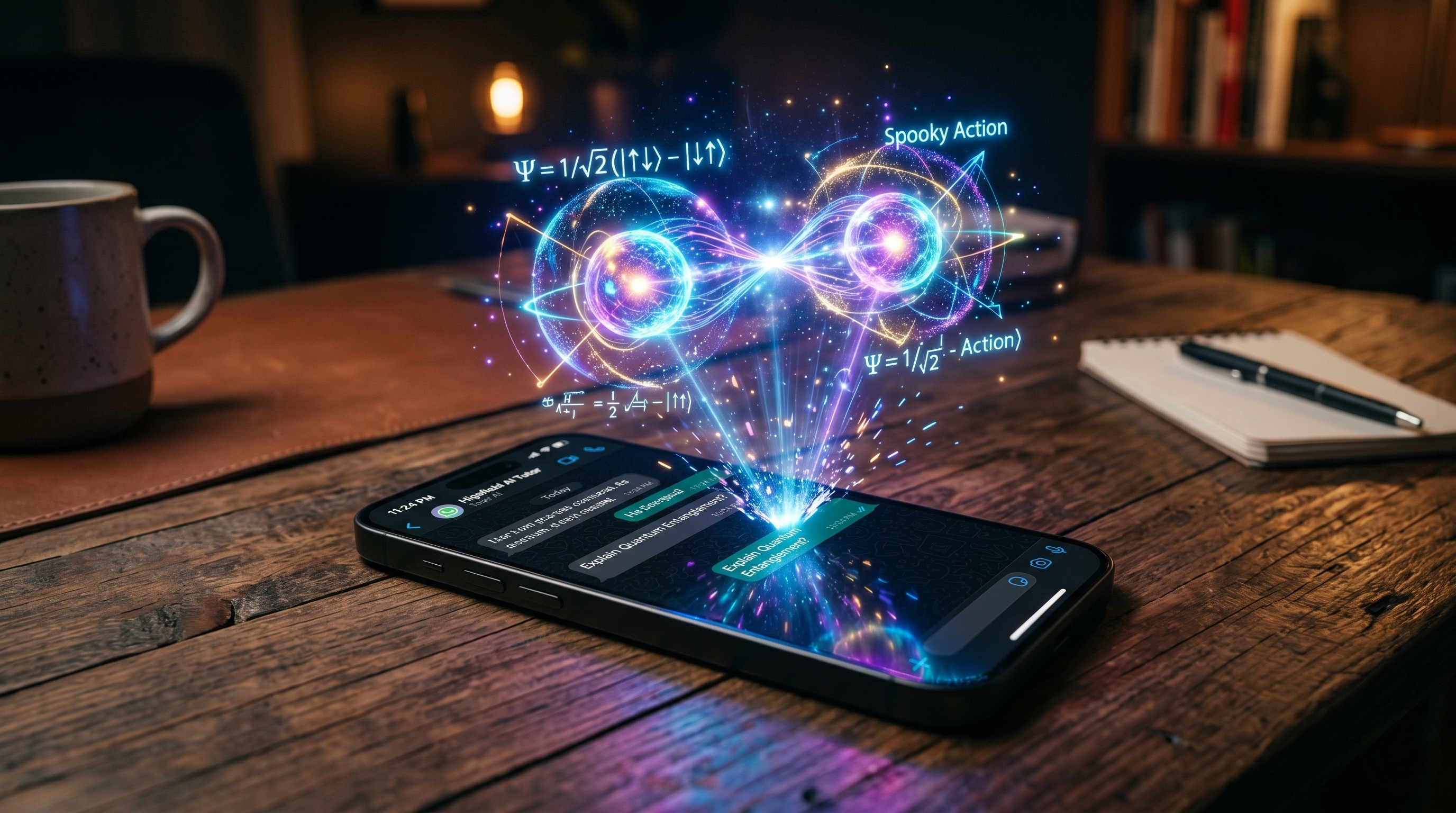
Everyone's been in that situation! You're engrossed in a tough chapter of a text book trying to make sense of a difficult scientific concept or staring at a mathematical concept that you just can’t wrap your brain around. Usually, you just put the book down, go to YouTube, type in what you are looking for and spend the next twenty minutes trying to sift through a lot of really bad video until you find the one you need. Or perhaps you would open up a really complicated AI video generator and have to struggle to come up with just the right prompt and then wait for it to produce the video.
What if you didn’t have to do any of this? What if you could just grab your phone, open your favourite messaging app, send a simple question to someone and then receive a custom made, cinematic video explanation back to you?
That’s now a reality with a recent integration between OpenClaw and Higsfield and can easily be implemented now. With this innovative integration you can instantly transform WhatsApp into the ultimate, custom built video tutor.
Here’s a quick snapshot of how this integration will revolutionise how we learn, receive information and interact with AI tools.
The Conclusion of "App Fatigue" & Complicated Prompting
Currently, the most significant source of friction we experience through the new generative AIs is the path to generate high-quality output, not the quality of the actual output itself. Presently, we are typically switching between multiple interface types (different software), extensive amounts of time spent logging into web-based portals, managing different subscription services, and learning how to "prompt engineer" properly.
Since Higsfield (a highly effective cinematic video generation model) has been integrated directly into WhatsApp, this removes any remaining barriers and/or friction to generating a video. For example, there is no need to download or open a separate application to generate a video; there is no requirement to access a computer; there is no longer a necessity to be able to formulate high-quality AI prompts.
All you have to do is send a text message as you would send a text message to a "smart" friend: for example, "Hey, can you explain chapter 11 of the book I'm reading about Quantum Entanglement to me, or can you show me how the combustion engine works." This is where the "magical" process of generating a cinematic video begins taking place behind the scenes.
Get to Know the Genius Behind The Scene: OpenClaw
Whenever you send a WhatsApp message, it doesn’t simply go into the black hole of digital media. Instead, the message will be intercepted by OpenClaw, which acts like your own personal digital assistant (or middleman), who will help transform a simple text message into the complex video generation engine required for the final explainer video.
OpenClaw has to memory and contextual awareness built into its operation. When OpenClaw receives a text message, it does not have to start from square one; therefore OpenClaw already has an abundance of information about who you are, including what book you currently have on your “to read” list, what specific topics are of interest to you, and the manner in which you prefer to learn (ie. The feeling you want when viewed through your preferred manner of presentation).
Do you prefer to have things explained in high-energy visual presentations? Or are you more comfortable with methodological step-by-step diagrams? OpenClaw will take your informal casual text message and rework that text into a completely detailed prompt specifically designed for you. OpenClaw will shape your raw question into an exact representation of the type of explainer you would like to see.
Higsfield, the Heavy Lifter
Higsfield takes over from OpenClaw when it has created the ideal prompt to give to Higsfield, which is a generative AI that creates high-quality cinematic video content.
Higsfield takes the instructions and starts working. Instead of producing a still slide or text summary, it generates an engaging and visually exciting narrative. Whether Higsfield produces 3D visual representations of cell division, cinematic depictions of historical events, or clean diagrams of math formulas, it renders them quickly and aesthetically.
Once Higsfield finishes rendering, OpenClaw waits and receives the video file, which is placed back into the user's WhatsApp conversation.
The entire process occurs in the background; after user submission of the question, the user can put the phone down for a few seconds and receive a buzz on their phone with the custom cinematic video that illustrates the concept.
Innovation through Repetition: Own the Experience
With the incorporation of a chat interface into your learning experience there is an unending flow of iteration available to you during that time. Learning is typically not a one-time event. There will be many times when the explanation originally given was clear but then upon seeing it in a different format you are able to understand what was being explained previously.
Since you are merely having a conversation on WhatsApp, repetition is very easy to accomplish. If the original video did not meet your needs, you can reply with commentary such as "That looked good but I need it broken down a little easier for me" or "Could you condense this into a concise 30 second summary?"
Furthermore, you may ask for the same idea explained in at least three different ways (with different examples). Or request that it is demonstrated using two different perspectives - one being a broad view and the other one being a narrow view. You can ask for whatever you feel will help you to finally understand a concept better through this type of casual communication (i.e., using a text message to request something). All of these requests will occur in the same chat thread providing continued context for the conversation so the AI can continually comprehend the content and provide appropriate feedback.
The Future of Learning Without Friction
The incorporation of these technologies into our education will change the way we interact with educational technology. We are stepping away from the time when we needed to learn how to communicate with machines and progressing towards a time when machines will learn how to communicate with us as human be-ing.
You should never have to stop what you are doing because of an issue with your reading or an obstacle while you work. When using one of your mobile apps that you use enough times a day and combining this with one of a few learning tools that you already know how to use, the process of gaining knowledge becomes frictionless; thus allowing learning to be a seamless transition into your everyday digital life instead of something that you would need to do separately.