.svg)
.svg)
 For Instructor
Think about the software running your life right now. Your Android phone? Running on Linux. The cloud that powers half the apps you use? Kubernetes. The website you're probably reading this on? There's a good chance React is behind it somewhere.
All three of these are open source. That means the code is free for anyone to see, use, and even improve. No secret sauce, no locked doors — just millions of developers around the world building on top of each other's work.
Here's the catch though. Despite India producing one of the largest developer populations on the planet, most Indian developers have never contributed a single line to an open-source project. Not because they can't. Mostly because nobody ever showed them how, or where to start.
That's the gap a nonprofit called FOSS United has been quietly closing.
What FOSS United Actually Does
FOSS United isn't just a community that meets up and talks about open source. It's built an entire ecosystem around it.
They give out grants to open-source projects that need funding to keep going. They run fellowships for individual contributors who want to go deeper into a project instead of just dabbling. They organize FOSS Hack, a hackathon built specifically around building or extending open-source tools. There are city communities in pretty much every major Indian tech hub, plus college clubs on campuses so students can get involved before they even graduate. And if you're wondering how open source actually pays the bills, they run a jobs board connecting people to companies that hire specifically for open-source work.
It's basically the whole pipeline — from "I have no idea what a pull request is" to "I get paid to maintain a project."
Who's Behind It
FOSS United is backed by Zerodha and Rainmatter, the team also behind Frappe, the framework powering ERPNext — one of the biggest open-source projects to come out of India. If you've heard of companies actually funding open source instead of just using it for free, this is what that looks like in practice.
And every year, this whole ecosystem comes together at one event: IndiaFOSS, the country's biggest open-source conference.
IndiaFOSS 2026: The Sixth Edition
This year's edition — the sixth one — is happening in Bangalore on September 26th and 27th, at the NIMHANS Convention Centre.
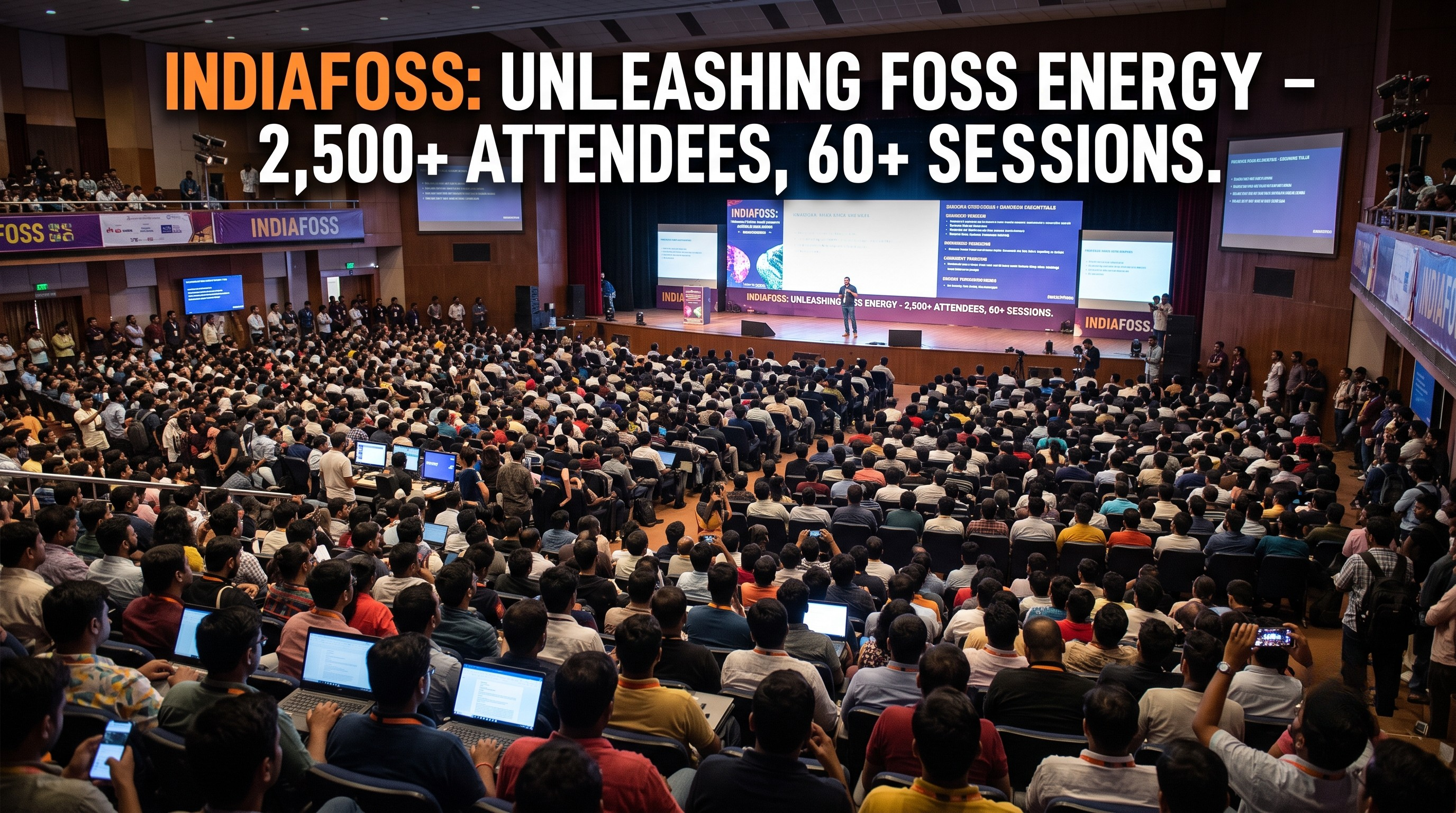
To put the scale in perspective: last year's edition pulled in around 2,500 people and packed in 60+ sessions — talks, hands-on workshops, live demos, and maintainer summits where the actual people running major open-source projects sit down and talk shop. It's not a conference where you sit through slides all day. It's a room full of people who build things, talking to other people who build things.
If you're a developer in India and you've never been to something like this, it's worth imagining what it's actually like. You're not networking with recruiters. You're talking to the person who maintains a library your code probably depends on. You're watching someone demo a tool they built over a weekend that might end up in your stack next year.
Why This Actually Matters for Your Career
Here's the part that doesn't get said enough: contributing to open source might be the single best thing you can do for your career as a developer.
Not because it looks good on a resume, though it does. But because it's proof. A resume tells someone you claim to know something. A GitHub profile full of merged pull requests shows them you actually built something, that other people trusted your code enough to put it into a real project, and that you can work with people you've never met, on a codebase you didn't write.
Companies increasingly know this. That's exactly why a jobs board tied to open-source contribution exists in the first place — it's a much stronger signal than another resume in a stack of a thousand.
You don't need to be a genius to start either. Every big open-source project has small, beginner-friendly issues sitting there waiting for someone to fix them. Documentation that needs updating. Bugs that need reproducing. Small features nobody's gotten around to. That's usually where every contributor's story actually begins.