.svg)
.svg)

 For Instructor
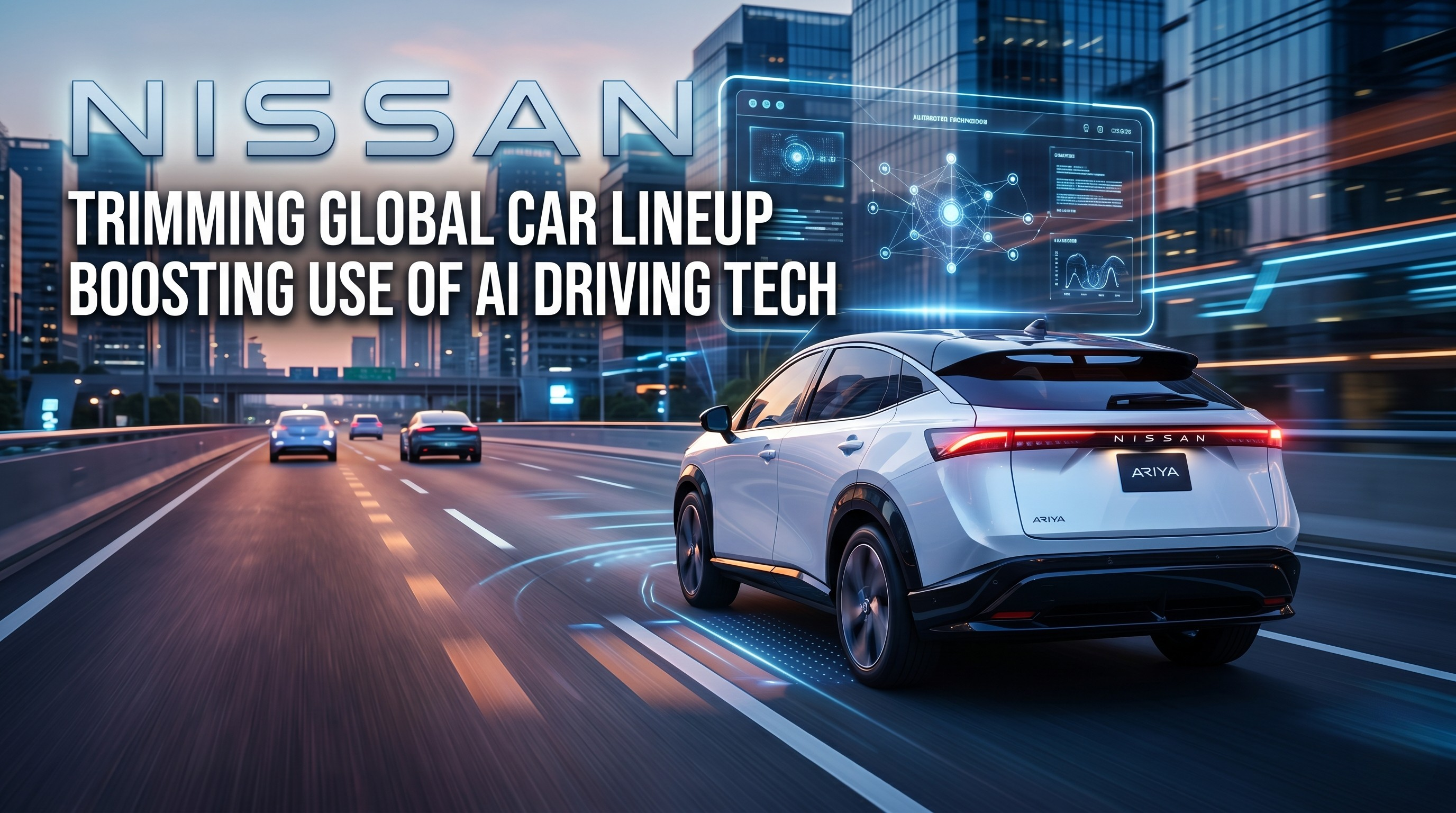
The Connection Between Less Clutter, More Brains: Nissan is Cutting Back Their Line Up To Be All In On AI
We've all seen how congested and overwhelming the automotive industry has become with every manufacturer constantly trying to one-up each other by creating new models, styles, and ways of delivering vehicles to consumers.
Historically, auto manufacturers have simply been providing customers with a different solution for every possible use of a vehicle. But the car makers have recognized that there is a real change occurring in how consumers shop/drive/experience cars and Nissan has finally taken notice.
Nissan has decided to implement a plan to significantly reduce their portfolio of vehicles sold globally while increasing their investment into next-generation AI game-changing driving technologies across their entire product line. They are taking a classic "quality vs. quantity" approach in order to revamp their image after experiencing significant challenges over the last 2-3 years.
If you are interested in how this will all play out when you next visit a Nissan dealership or how advanced the next vehicle you purchase will be, grab a drink and read on, as we break down Nissan's exciting new initiatives and explain why less can mean so much more.
Reducing the Model Range: From 56 to 45
Let's begin by discussing Nissan's hardware. Nissan currently has a global range of 56 different types of vehicles that it manufacturers, a large number to keep track of and maintain, considering how extensive Nissan's operations and logistics are worldwide. It is difficult for Nissan to manage and keep their production lines running smoothly, as well as marketing, supply chain, and maintenance of spare parts at all dealership locations.
In order to better streamline its manufacturing and focus only on what is working for them and remove any low-performance vehicles, Nissan has decided to reduce the amount of vehicles it sells worldwide by cutting its range to 45 vehicles from 56 vehicles.
Why Should Nissan Reduce its Model Range?
Save Money: By reducing the number of models that are manufactured and limiting the amount of money spent on manufacturing obsolete or low-selling vehicles, Nissan can reduce costs by billions of dollars and redirect that money toward their research and development.
Control Inventory: There is presently an enormous inventory crisis in the automotive industry (as seen recently with Tesla's inventory woes), and producing vehicles that are going to sit on the dealer's lot is just going to put the company at financial risk.
Re-Focus on Winning Vehicles: By eliminating underperforming vehicles, Nissan will be able to refocus its primary emphasis on its most-profitable vehicles, such as popular SUVs, Infiniti luxury vehicles, and its new electric vehicles.
While it will be sad to see some of the quirky vehicles disappear from the market, eliminating them is a necessary part of survival for an automotive manufacturer.
Artificial Intelligence Revolution at Your Doorstep
We now arrive at the really fun part—the brains behind the operation. Part of the strategy is to cut down on the cumulative amount of cars to grossly reduce the total number of marques, however there is still another 50% to the plan: the cars that make it through, will be smarter, safer, and much better equipped than they have ever been.
Nissan has announced long term plans to have their artificial intelligent driving technology deployed on 90% of their vehicle models and product lines, what does “artificial intelligent driving technology” really mean in everyday terms? We’re not just talking about cars that beep at you when you cross out of one lane and into another, we are talking about fully autonomous vehicles providing highly advanced capabilities from end to end.
Robotaxis and Smart Transit Solutions
To achieve this vision Nissan is engaging in extensive strategic partnerships with outside talent and in addition to working with internal engineers. They will be working in concert with UK artificial intelligence start-up Wayve and ride-hail driver provider Uber - they are attempting to develop robotaxi pilot programs in Japan by 2026.
Wayve is an expert with a unique AI model; the application of its AI based driving technologies is done best by relying on real world driving scenarios, not computer-based simulations. Through research and analysis of driving patterns across a very large set of training data to evaluate how people learn how to drive through experience versus purely relying on programmed standards.
Nissans intends to apply this motorised technology in their family car this remodelled Elgrand, a new generation of minivan, by the end of FY2027 when Advanced Driver Assistance Systems (ADAS) will be deployed. With these new ADAS features, imagine going on a road trip with your family, where your vehicle can manage long stretches of highway driving and all of the several intricate traffic changing modes as well as being able to control itself and park into a free parking spot, while still being able to provide you with real-time feedback about its surroundings (such as whether or not it is raining). With their commitment of deploying this technology into approximately 90% of its fleet, Nissan is democratising artificial intelligence so that automakers and owners of entry level vehicles are not excluded simply due to the cost of manufacturing (i.e., high end vehicles).
The Global Chessboard: Targets for 2030
Nissan has presented a new long-term vision due the fact that it is now the 4th largest automotive manufacturer in Japan, but behind giants such as Toyota and Honda who have placed pressure on Nissan; thus Nissan's response to regain their world standing and position, is to create very precise aggressive sales for the closing of this decade (2030 Financial year) and has broken the three largest automotive markets in the world.
1. United States - 1 Million
The United States is passionate about the automobile, and the overall automotive market shows a strong preference toward vehicles produced in the United States. Nissan's aggressive target of one million (1,000,000) annual vehicle sales in the U.S. by 2030 will require Nissan's transformation in how they create their products.
Currently, approximately sixty percent (60%) of Nissan's sold in the U.S. market are built in-market, and Nissan will increase their percentage of in-market production to a total of eighty percent (80%) over the next several years. By manufacturing vehicles that are built in the U.S. Nissan will reduce the cost of shipping products internationally; elimination of cost related to tariffs and receipt of the benefits associated with local government support for electric vehicle manufacturing.
2. China: 1 Million Vehicles
China is at the centre of competition for the future of the automotive industry. The emergence of domestic manufacturers such as BYD, who are producing highly competitive, affordable electrified vehicles, has caused the international automotive manufacturers to feel increased competitive pressure. Japan's Nissan is moving very quickly to generate a sustainable base of operations in China to facilitate both its growth in China, as well as use China as a global base for exporting. Nissan has made it a strategic goal to develop its export capabilities. An example of this would be the new N7 electric sedan that Nissan will manufacture in China and export to Latin America and the ASEAN region. The strategic shift in focus from the in-market China opportunity to a global and larger market opportunity has provided Nissan with a real manufacturing advantage over its competitors.
3. Japan isa Large Vehicle Market
Nissan, their home market, has the goal of increasing their volume of car sales to 550,000 annually by the year 2030. A key component of this strategy is to develop an entirely new series of compact cars beginning with the 2028 financial year. The market in Japan is ideal for hyper-efficient, compact cars that are equipped with artificial intelligence due to the density of the population in cities, and the narrowness of the roads.
"The Arc," the Way Nissan Will Progress Sustainably
Though some big changes are taking place at Nissan, such as reducing their product offerings, putting more emphasis on artificial intelligence, and implementing sales targets by geographical region, these changes are all part of a larger business plan that was first announced by Nissan's Executives, and is the bridge between the restructure of the company and its long-term vision (Nissan Ambition 2030).
The Arc is built on a few core concepts:
Balanced Electrification. Nissan knows that there won't be an overnight transition to 100% electrification, so they are looking to provide a mix of internal combustion engine vehicles and full electric vehicles according to the level of electrical vehicle infrastructure available in each region.
Cost Equalization: Through shared development of electric vehicles (EV), modular manufacturing processes, and investment in next-gen battery technologies (solid-state batteries), Nissan is targeting to reduce the price of EVs by 30%. Ultimately, Nissan’s goal is for the cost of building and purchasing an EV to be equal to the cost of building and purchasing a gas-powered vehicle by 2030.
Financial Rigour: As part of the turnaround plan, Nissan has already made several difficult decisions regarding its global production and a 15% reduction of its workforce. This “lean and mean” strategy is aimed at achieving positive operating profit margins of over 6%.
What Nissan's Corporate Restructuring Means for You
If you're wondering why you – the daily commuter or tech lover – should be concerned about Nissan's corporate restructuring, it's because it is going to fundamentally change the cars you will have access to in the upcoming years.
1.) More Technology In Affordable Cars: Nissan is planning on providing their driving technology (AI driving technology) standard in 90% of their models. This means that the advance safety and convenience features will no longer be underneath premium trim packages. The average car is about to gain tremendous baseline intelligence.
2.) Less Model Choice, But Higher Build Quality: Automakers that focus their engineering resources on 45 models instead of 56 typically experience higher build quality, software integration, and dependability in those remaining models. So while you may have fewer vehicles to choose from at your dealership, you'll have many more very good choices.
3.) The Return of Infiniti: If you're a luxury vehicle aficionado, Nissan's plans to bring Infiniti back to life with many models means stronger competition in the luxury vehicle segment (Lexus, BMW, etc.) and will cause all manufacturers to step up their innovation.
4.) Less Expensive Electric Cars: Nissan's focus on reducing battery costs and simplifying manufacturing (The Arc plan) will create an unprecedented decrease in the cost of entry for purchasing electric cars.
The Past & Future of Automobiles
Nissan is finding this time in the automotive market to be extremely competitive. With inconsistent global economies and new EV startups popping up everywhere, it will not be able to rely on its existing products to keep it alive as a company.
By drastically reducing the number of products offered and increasing the amount invested into the use of "AI" throughout their global operations, Nissan has shown that it intends to not only be an average automotive company but to be one of the leaders of the future in this rapidly changing automotive environment. For that reason, while there are no guarantees in life, with cars continuing to morph into "computers on wheels," placing your bet on brains rather than bulk is probably Nissan’s smartest decision at the moment.
Next time you are inside a Nissan vehicle, be sure to take a close look at your dashboard as chances are it is one of the smartest, most technologically advanced products on the road today.