.svg)
.svg)
 For Instructor
In recent years there has been a clear leader among all laptops; when Apple introduced their M series chips, they completely changed the way we use computers. All of a sudden, there were extremely fast computers, so quiet you cannot hear them running and with battery life so good it seemed like magic. Since Apple released their M series chips, other computer manufacturers from the PC market have been trying to develop the right combination of power and thermal performance.
Nvidia has created a product that will prove to be the biggest competitor to MacBook products in history; the RTX Spark.
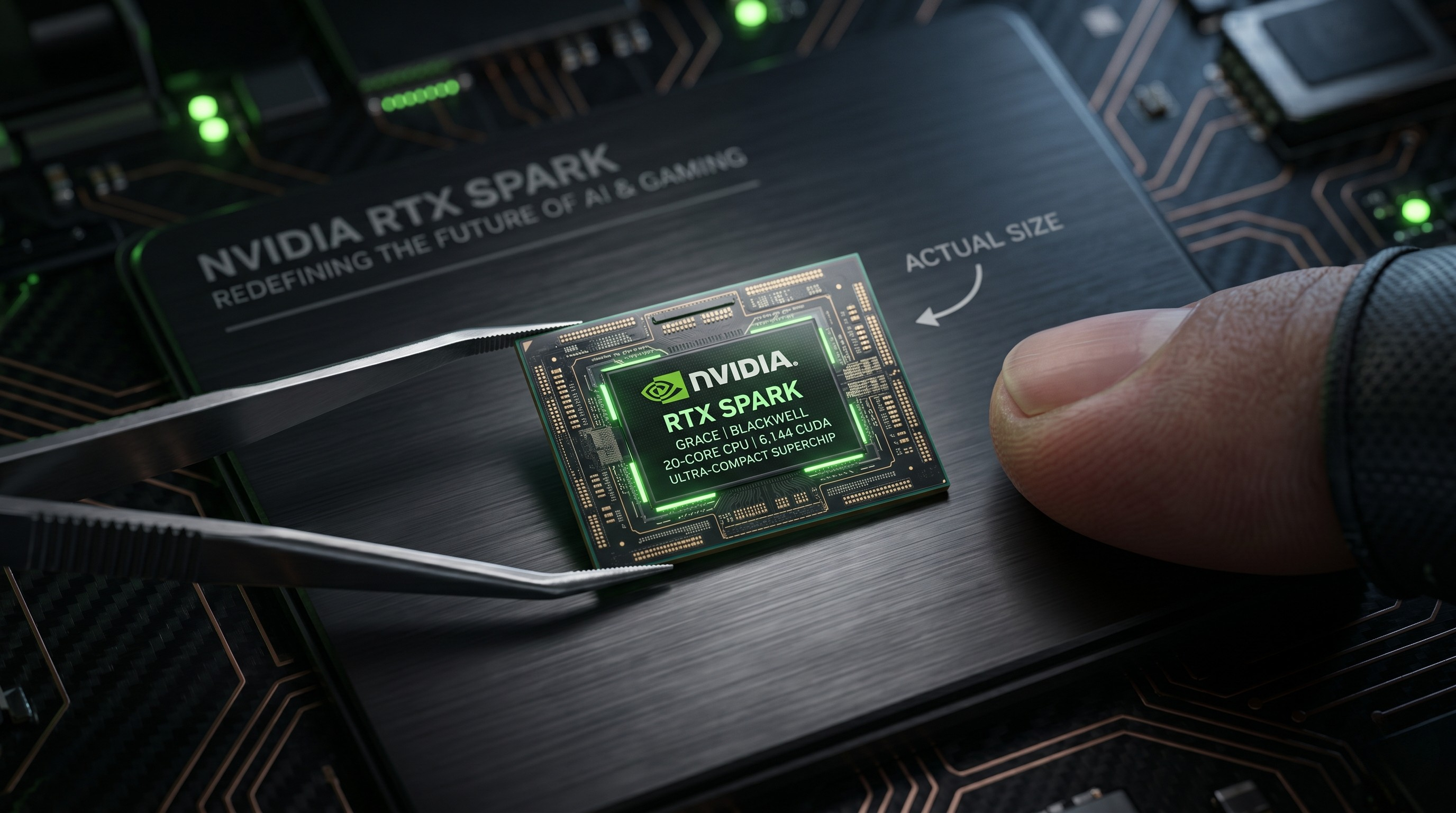
The RTX Spark is not just another incremental or minor update, it is an absolute redefinition of what a laptop chip can do. Now before I get into the mind-blowing specs of this unprecedented piece of technology, we will first examine how incredibly tiny this piece of silicon actually is. It is almost impossible to believe that this tiny piece of silicon is about to change the rules of mobile computing and the whole PC form factor.
Unwrapping the RTX Spark
The RTX Spark is an amazing piece of technology. It's one chip made up of two different silicon components that work together perfectly: A 20-core Grace CPU and a latest generation Blackwell GPU.
If you're a desktop gamer, the next spec will surely blow your mind: The Blackwell GPU has a whopping 6144 CUDA Cores! Yes, you read that correctly - this is the same number of cores as a top-of-the-line desktop RTX graphics card. We're not talking about "mobile equivalents" and downscaled versions of the desktop GPUs that struggle against their bigger brothers. These are desktop-quality graphics were crammed onto a single chip so that they can be used in a thin laptop.
Nvidia has achieved this by building a unified memory architecture for the two components, similar to the way that Apple has built their own very successful silicon; however, they have infused the combined components with Nvidia's best-in-class graphics and AI acceleration. The CPU and GPU share one large pool of shared ultra-fast memory, which completely gets rid of the major performance bottlenecks that typically slow down heavy workloads.
The Next Generation of "Personal AI"
Artificial intelligence (AI) seems to be everywhere today; it is used so frequently that it can feel like nothing more than a buzzword. However, the announcement made by NVIDIA CEO Jensen Huang regarding the RTX Spark’s AI processing capability is nothing short of groundbreaking.
According to Huang, this small chip has enough processing power to run a 120 billion-parameter model entirely offline.
For reference, this amount of processing power would allow you to run a model of AI that is comparable to some of the most powerful Large Language Models hosted in the cloud today, on your local machine, with no internet connection, monthly fees, or fear that your personal information and/or private business transactions may be sent to a server farm on the opposite side of the country.
As the user inputs information, the PC performs the work. Whether you are a developer trying to develop the next big thing, a digital artist working on large-scale 3D rendering projects, or just a power user who wants a highly intelligent agent that resides on their device and doesn’t leave their home, the RTX Spark is a true “personal AI” experience. It is basically taking a supercomputer and placing it in a backpack.
The Ultimate Advantage: AAA Gaming on Battery!
Apple has deservedly received much praise for their M-series chips; however, one glaring omission is gaming. Regardless of how effective Apple’s silicon has become, they have yet to establish themselves as a force in the AAA gaming industry.
Nvidia’s RTX Spark demonstrates this by providing an unparalleled advantage over all of their competitors.
As an Nvidia chip, it leverages all of the company’s legendary gaming hardware resources – including hardware-based ray tracing, Reflex for ultra-low latency; and most significantly, DLSS 4.5 with frame generation features.
These technologies enable you to play graphically intense, AAA quality video games like 007 First Light and Forza at 1440p resolution, and 100 fps!
There is one last amazing thing that the RTX Spark can do – run on battery!
In the past, to have a gaming laptop perform well you had to keep it plugged in to an outlet all the time. If you unplugged it, the fps would drop dramatically within seconds and you'd run out of power in about 45 minutes. RTX Spark breaks away from that traditional compromise. By using the power of the Arm-based Grace CPU and the AI-assisted upscaling of DLSS 4.5, it is able to provide high-end desktop gaming performance in a portable unit and doesn't require you to keep it plugged in at all times. This is the utopian vision that laptop gamers have been pursuing for years.
The Future of Computer Design
The RTX Spark represents a significant step forward not only in performance but also in terms of how we use computers at home.
For years, anyone who wanted to enjoy the most powerful gaming experience possible had to spend upwards of $1,000 on a full-sized desktop PC: an enormous tower, a dedicated motherboard, a huge external power supply brick, a separate graphics card the size of a shoe box, and multiple cooling fans to keep everything cool enough that it wouldn’t catch fire.
With the RTX Spark, it is now possible to create a very small form factor computer with a 20-core CPU and a massive 6,144 GPU on one integrated chip. Doing so makes it possible to build high-performance computers without the need for traditional desktop form factors.
Consider this. A tiny brain with minimal energy uses a lot less chassis than a traditional computer. Now imagine having ultra-thin laptops that can out-perform a standard size desktop from not too long ago. And for those who prefer a standard size desktop, the typical `tower` will likely shrink down to something the size of a hardcover book, yet deliver 1 petaflop of AI processing power and gaming ability similar to larger PC's on the market.
The RTX Spark also enables hardware manufacturers to build ultra-slim, minimalist designs without sacrificing an ounce of performance. The extra space in the chassis created by removing the size and power of the computer's `brain` allows for larger batteries, improved speaker systems, and innovative cooling solutions, giving you a surprisingly lightweight and very thin device.