.svg)
.svg)
 For Instructor
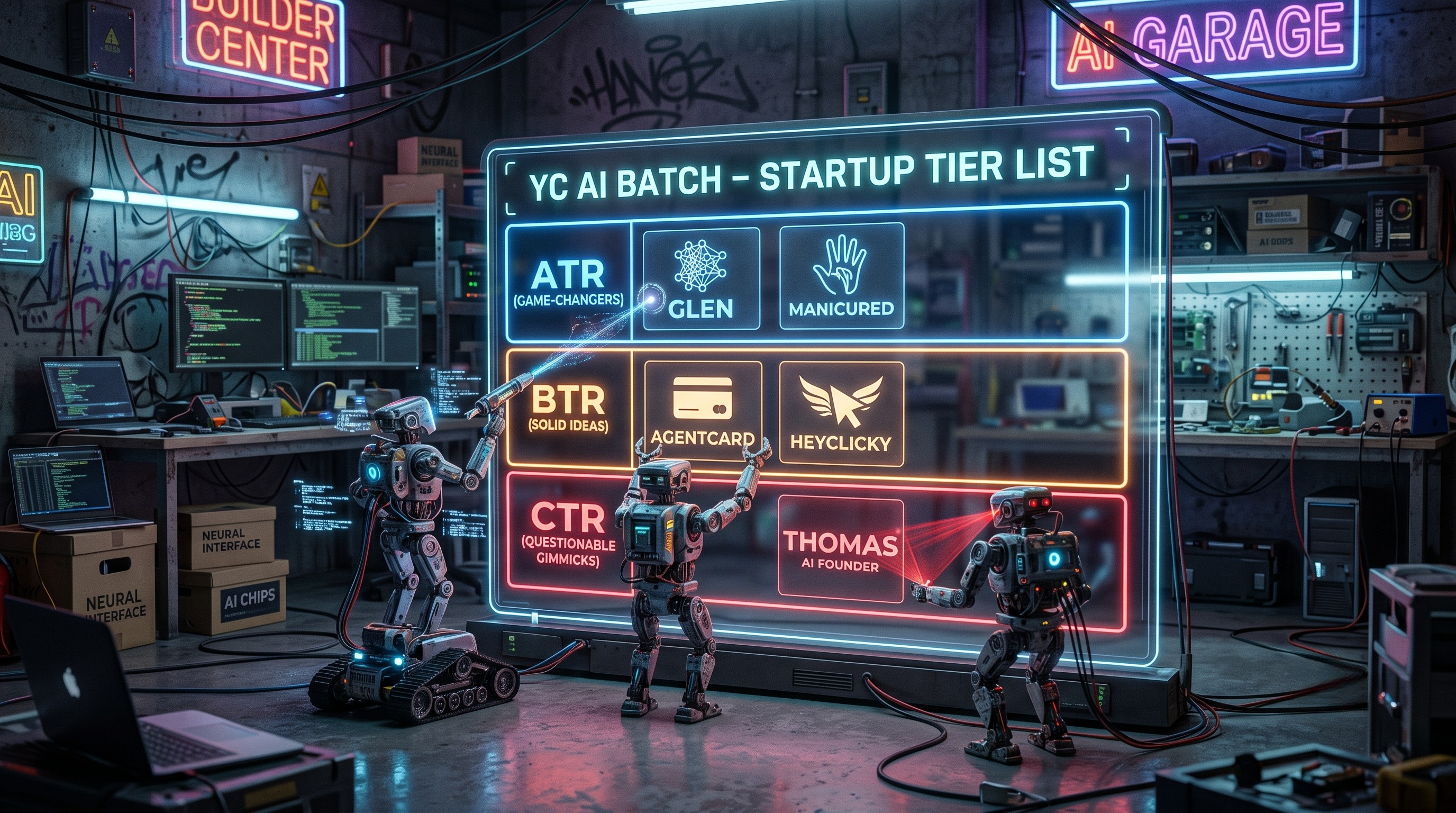
These are the startups that look at a glaring, massive problem in the AI ecosystem and tackle it head-on. They aren't just building cool toys; they are building the foundational infrastructure that the next generation of AI will actually rely on.
Glen: Shared Learning for AI Agents
First up on our list is Glen. Without a doubt, this one goes straight into the A-Tier (ATR).
If you work at a tech company, you probably already know the biggest paradox in AI adoption right now. Your junior-most employees usually have the highest context and understanding of how to use AI tools, but they have zero historical context about the company itself. They don't know why that weird piece of legacy code was written five years ago, or why a specific sales deal stalled last quarter. On the flip side, your most senior leaders know absolutely everything about the company’s history, but they barely use AI in their day-to-day workflow.
This creates a massive disconnect. Glen steps in to bridge this gap by providing a unified organizational context for agents and humans alike. Imagine hiring a Day-One employee (or deploying a brand-new AI agent) and having them operate with the exact same judgment, institutional knowledge, and nuance as your most senior executive. Glen reads from where your work already lives—code repositories, Slack threads, docs, and meeting notes—and reconciles it. When a bug bot flags code, it actually understands the intent behind it. This is honestly solving one of the most painful bottlenecks in enterprise AI right now.
Manicule (Manicured): AgentRel is the New DevRel
Next up, we have Manicule (often floating around as Manicured). This is also a solid A-Tier (ATR) for me.
We are entering a world where AI agents are making decisions on behalf of humans. So, how do you make sure an AI agent actually picks your product to use? Manicule is essentially doing everything Developer Relations (DevRel) used to do, but they are rebuilding it for a world dominated by AI.
They handle technical documentation, Generative Engine Optimization (GEO), and content sourcing to ensure that your product gets discovered, understood, and integrated by AI agents. Getting discovered by an agent is basically its own full-time job now, and traditional SEO tools are completely broken for this use case. By structuring docs and technical content so that an AI can easily read, test, and implement it, Manicule is creating a brand new growth channel. If you want to survive the next five years in SaaS, you need agents to understand your API. Manicule makes that happen.
The B-Tier (BTR): Great Ideas, But With Caveats
This tier belongs to startups that have genuinely cool products, strong founders, and great distribution. However, they face looming existential threats from bigger players or are treading water in a market that has historically been brutal to crack.
Agentcard: Debit Cards for AI Agents
Moving on to Agentcard. I am putting this in the B-Tier (BTR).
The pitch is incredibly fun: it is a literal debit card for your AI agent. Right now, AI agents are smart enough to research products, plan trips, and fill out forms, but the second they actually need to buy something, they hit a brick wall. Handing an AI your personal, un-capped credit card is a terrifying idea (one bad prompt, and you've accidentally bought twelve lawnmowers). Agentcard solves this by letting you fund a wallet, set a strict budget, and issue single-use virtual cards for your agents to use.
I mean, cool! It works. Agents can finally make payments autonomously. But here is my hesitation: making payments on the internet is a deeply saturated space. I feel like way too many crypto and Web3 startups tried to solve programmable, autonomous payments years ago, and almost none of them took off the way we expected. There is definitely something to learn from that era. While the product is incredibly useful, the long-term defensibility of a standalone AI debit card remains a question mark.
HeyClicky (Clicky): The AI Cursor Buddy
Next on our list is HeyClicky, and I think this also belongs in the B-Tier (BTR).
HeyClicky is a fantastic product with a great founder and incredibly smart distribution. It is essentially an AI buddy that lives right next to your computer cursor. You can just talk out loud, ask a question, and it sees everything on your screen to help walk you through whatever you are working on. You can tell it to spin up a background agent to do research or manage your calendar, all with zero setup. It is quite literally the simplest AI interface in the world for everyday consumers.
The reason it doesn't quite make the A-Tier is the platform risk. When you build a feature that sits on top of an operating system, you are always racing against the clock. I strongly believe that whoever owns the hardware—whether that is Apple with Apple Intelligence, Google, or Microsoft—will just build this capability natively into the OS within the next two years. HeyClicky is amazing right now, but surviving the impending native OS integrations will be an uphill battle.
The C-Tier (CTR): Time for a Pivot?
Sometimes, startups lean a bit too hard into the marketing gimmick rather than the underlying utility. This brings us to our final tier.
Thomas: The "AI Founder"
Last on our list today is Thomas, and unfortunately, I have to place this in the C-Tier (CTR).
This is roughly the one-thousandth company claiming to be the "first AI founder." Look, the actual underlying product might work just fine. There might be some really solid code and a decent workflow automation tool under the hood. But the positioning is just so incredibly tired.
We are past the novelty phase of Generative AI. Slapping the label "AI Founder" on a product is not an out-of-the-box, mind-blowing marketing strategy anymore; it is exhausting. Consumers and investors alike are looking for real, tangible value, not a mascot pretending to run a company. If they drop the gimmick and focus purely on the utility of what the software actually achieves, they might climb the ranks. But for now, the positioning alone drags it down to the bottom of our list.