.svg)
.svg)
 For Instructor
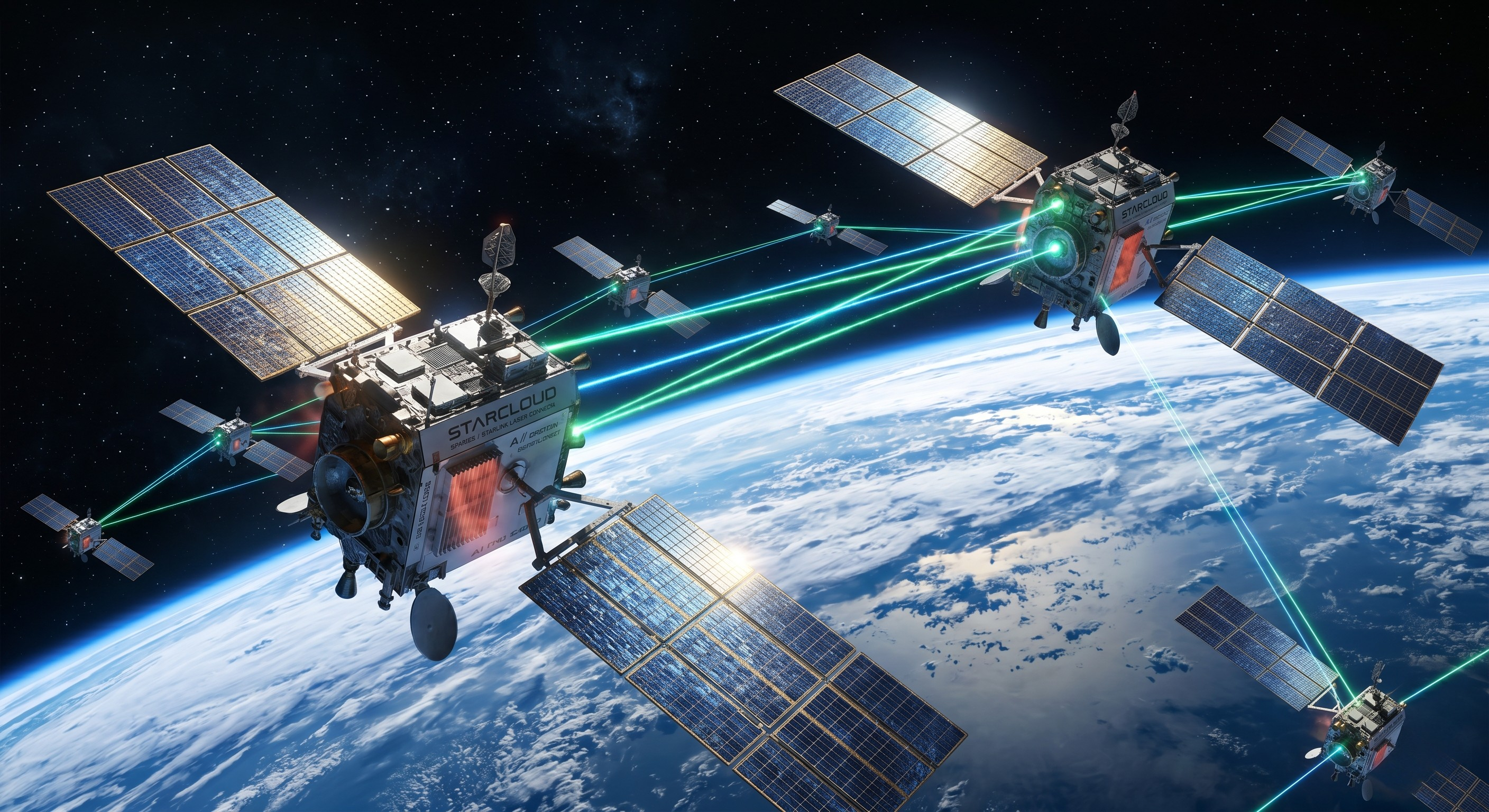
Three of the top artificial intelligence companies will soon be heading to outer space, courtesy of Elon Musk. If you have been thinking that the artificial intelligence competition has only been going on in giant warehouses located in California and Texas, think again; the new Silicon Valley has just become orbit.
Welcome to day 41 of the AI daily update.
Currently, at this very moment, a revolution is occurring a few hundred miles above us. A company called StarCloud has recently signed an enormous contract with SpaceX to place Starlink laser communications terminals onto StarCloud's satellites. This is not a cool science experiment; it is the foundation of moving the entire internet, and all the artificial intelligence associated with it to another planet.
This is the beginning of a new technological age, and here is exactly what is taking place, why the world’s largest technology companies are on their way to orbit, and what it means for the future of the technology that we use every single day.
The Problem with Planet Earth
In order to understand why we’re launching AI into Space, we must look at the large bottleneck that exists at ground level. The conversation surrounding artificial intelligence has typically revolved around software - who has the smartest models, who has the technically superior Coders, who creates the most realistic looking video and so forth. However, the limitations on using artificial intelligence no longer are found with the software; instead they’re located in physical infrastructure.
In order to operate and train large artificial intelligence systems requires an incredible amount of energy, advanced cooling systems and real estate. New builds of artificial intelligence data centres have already overtaxed existing electric grids in the United States and Europe. Obtaining building permits to construct new energy facilities or erect a plethora of new server farms is taking several years, and as of yet, we are not producing any new energy generation facilities to keep pace with this growing demand for energy. The tech industry is competing with one another over Nuclear power, locking in long term energy contracts while working to secure their energy future.
In a blunt assessment, the planet is running out of available surface area and available energy resources that are necessary to continue this growth in AI.
Connecting the SpaceX to StarCloud
StarCloud has provided the answer concerning the construction site for their next generation of AI data centers by asking a simple yet radical question: What if we build these data centers in space (the final frontier)? This will allow them to take advantage of the almost constant solar power and eliminate the burden of having to comply with zoning laws or use local water supplies to cool off their servers, or to fight an uphill battle with the local electrical grid. Together, it allows them to take the excess heat from AI processors and dump it directly into space, the cold dark void of the universe.
This is not simply a thesis paper or just theory. In November of 2025, StarCloud sent an advanced Nvidia H100 computer chip into orbit and successfully used it to train a fully operational AI in space. It is important to note that the next spacecraft is already in construction with 100x the power generation and cooling capacity.
If no one can communicate with an advanced computer system in space, it will be worthless. Satellite platforms that gather information such as high-res weather pictures or data tracking wildfires have historically transmitted all of their collected raw data back to Earth for processing. This includes relaying their information to ground station facilities which can create a significant delay. Ground stations have limited bandwidth and satellites only communicate with ground stations when they are in direct line of view above them.
StarCloud has secured an agreement to install Starlink's Mini Laser terminals into its StarCloud satellite constellation.
The Laser Mesh Network
Starlink already utilizes space lasers to broadcast high-speed internet around the world; by deploying these same devices on StarCloud's data centers in orbited locations, the Starcloud satellites can communicate directly through lasers at extremely high speeds of up to 25 Gbps.
In the past, one passive satellite would collect the data and wait for a ground station to $('#'load')' or dump it into Earth; now, two neighbouring satellites (one that has collected the data) can copy each other's data and transfer it at some very high speed over the laser mesh link. Not only that, but a lot of that computing can also occur in orbit with artificial intelligence (AI) taking care of the processing in real-time; only the final, light-output data will be transmitted back to the user.
The optical laser mesh forms part of the connecting tissue that converts a number of isolated metal boxes into a huge, operational distributed supercomputer.
Anthropic is ‘In Space’
Many may have assumed that StarCloud was the only player in space computing, but Anthropic (the organisation behind the renowned Claude AI) recently entered this market when they signed a new significant computing contract with SpaceX to utilize their supercomputer, the Colossus 1, offering them access to over 220,000 Nvidia GPUs for new computing capabilities. Anthropic has publicly stated they needed to limit their user experience and downscale user demand during peak hours due to insufficient servers, and as a result, they have contracted with SpaceX for the use of their supercomputer.
Perhaps the most significant thing about this agreement is the fact that Anthropic is looking to establish an AI server farm in orbit, encompassing multiple gigawatts of compute power, instead of simply signing a lease for servers in Texas as many assumed. Anthropic believes that to go from current AI capabilities to whatever the next generation of AI will be require computing resources that cannot reasonably be accommodated by the ground’s power grid. As a result, The new partnership with SpaceX will provide Anthropic with access to the necessary computing resources and infrastructure to accomplish this goal.