.svg)
.svg)
 For Instructor
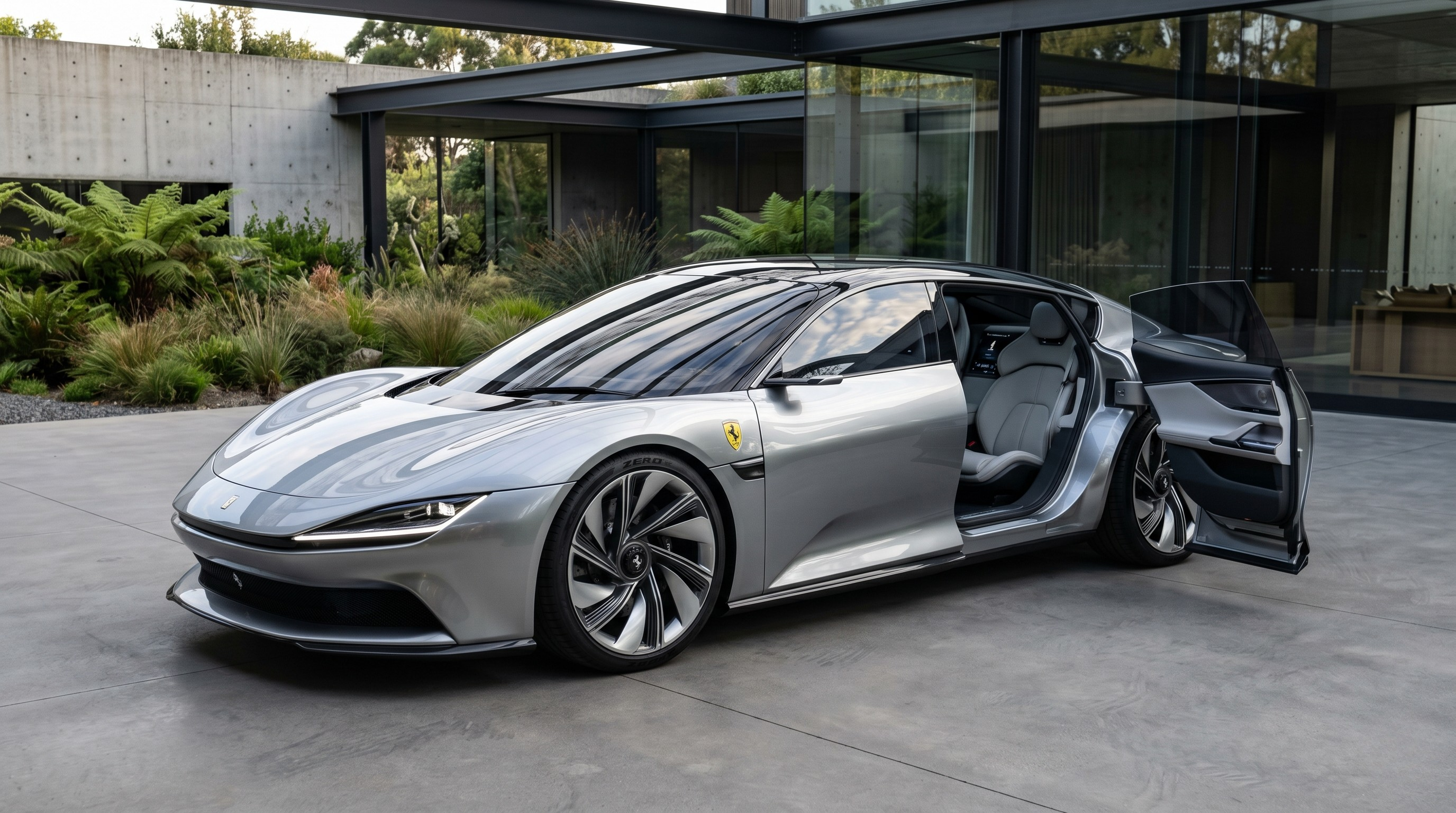
Did you ever think Ferrari would actually produce an all-electric car? For years, the Italian car company created its identity around the loud, mechanical sound of a combustion engine. But now that it has arrived, it looks like an Apple device.
Ferrari has released its first all-electric vehicle, called the "Luce" (pronounced loo-chey). In Italian, the word luce means light, but there's some humor around the Internet about people calling it the "loose."
Hardcore Ferrari enthusiasts should sit down, as this is not your traditional V12 supercar. Costing an astonishing $640,000, the Ferrari Luce is a large, five-passenger glass-based electric vehicle developed in collaboration with none other than Sir Jony Ive, the former designer of the iPhone, MacBook and Apple Watch. It is a significant move away from everything Ferrari represents and that seems to be the point.
The Specifications: A Ferrari For The Future, Not a Classic/
Though we will get to the polarizing looks of this car later, let’s start with something more objective—the specs; this car is still an absolute plus on paper. Ferrari did not simply stick a lot of batteries into an existing chassis and essentially offer nothing new; it designed and built a completely new chassis with new mechanical systems and electronics.
Equipped with a total of 4000 hp from 4 independent electric motors, each one located on an individual wheel, The Luce does provide you with blistering speed when needed. For a performance car, its ability to accelerate from 0-100 kph (0-62 mph) in just 2.5 seconds, as well as attain top speeds of over 300kmh (186 mph), presents no problem, or mystery.
Weighing in excess of 2000kg (almost 5000 pounds) would be an abundance of weight for a Ferrari without the 640kg battery pack to contribute to the vehicles overall weight. To counteract potential driving dynamics issues caused by the vehicles weight, Ferrari's engineers have designed a unique active suspension geometry system that will drop the vehicle 10mm when in cruise mode for increased aerodynamics and to create a higher level of traction to the roadway.
A Minimalist Approach To Automotive Design By Jony Ive (LoveForm)
What Inspired Jony Ive To Redesign An Already Great Supercar? Ferrari's Love From, A Design Firm Co-Founded By Jony And Longtime Collborator Marc Newson, Has Transformed The Design Of The Luce. So Far, The Executives At Ferrari Are Calling It This "Polarizing" Design.
While You Would Expect That A Modern Hypercar Would Have A Lot Of Sharp, Aggressive, And Wind-Tunnel-Tested Corning, The Shape Of Luce Is A Smooth Glass Tear Drop. The Top Half Of The Vehicle Has A Continous Sweeping Panoramic Glass House Which A Great Do Not Match The Aluminum Panels That Make Up The Body Of The Car. The Luce Has No Fake Grills Or Un-Used Vent Holes That Are Just There For Appearance. The Final Result Of Jony's Minimalist Philosophy Will Result In An Amazingly Clean Design That Is Extremely Futuristic In Nature With An Aerodynamic Drag Co-efficient That Is The Lowest Drag Of Any Car Ever Built By Ferrari.
The designers and the Ferrari team decided on a specific design style for the interior of this car. The design is a much different look than what most EVs look like inside as well. They worked with Samsung to make a digital layer that uses OLED technology as part of the way that they display information in the car. The actual hands of the watches function alongside the screens as they turn on and off; they also maintain their position in an exact manner on the screen as they do so. All of these components are very pleasing to the eye and give off a wonderful combination of old-school analog style with modern digital technology combined together in a style/design that has been built to last.
What? Rear-Hinged Doors and Five Seats?
With the battery pack and the glass roof combined to surprise us, now we can throw another unexpected rule in regards to Ferrari; it has 5 seats!
For a long time now, the only (traditionally) offered Ferrari vehicles were low, 2 seat sports cars, the occasional (2+2) Grand Tourer, and more recently, the Purosangue SUV. Due to the fact that EVs do not need the traditional bulky "transmission tunnel" in the centre of the vehicle, Ferrari was able to make the cabin area larger and accommodate 5 seats comfortably. They also added rear-hinged doors, to equally help passengers enter and exit the backseat area.
Clearly, Ferrari is NOT targeting this vehicle toward weekend track warriors; instead, they are clearly targeting ultra-wealthy families and high-tech entrepreneurs that want to drive their Ferraris to work daily, without the impracticalities of an old-school hypercar.
The elephant in the living room -- the sound
Let’s be honest for a minute here: when you purchase a Ferrari, you aren’t simply buying a car that has fast 0-60 mph times. You are buying a feeling. You are buying what it means for an engine to run perfectly at 9,000 revolutions per minute (RPM). The experience of driving one is something you can actually feel inwardly as well as outwardly, unlike an electric car which is inherently silent.
So now, how do you create an experience driving a Ferrari that will give you the same feeling of driving a Ferrari?
The engineers at Ferrari understood that they could not produce a vehicle that was silence when the vehicle was being driven, nor did they want to simply play a synthetic MP3 file of the sound of the V8 engine through the speaker system of the vehicle. Therefore, Ferrari’s team has created a system that records the actual electromagnetic sound being produced by the four electric motors and amplifies it. The true mechanical sound produced by the electric motors will be modulated and shaped to produce an entirely new sound signature for the Luce that is unique to Ferrari – part electric guitar, part spacecraft and part mechanical whine. Will this sound come close to replacing the pulse-quickening wail of the 458 Italia? No, however, the Luce has less of an auditory signature and a more futuristic sonic personality.
Reasons for Ferrari's Decision?
You may be asking yourself why Ferrari, a brand with such deep connection to gasoline and mechanicals, would make such a radical departure from that legacy. The reality is that the automotive industry is changing, and if Ferrari is going to remain relevant into the next century it has to begin evolving to meet those changes.
Ferrari isn't trying to fool anyone with an "all-new" car for everyone. In fact, Ferrari's Chief Marketing Officer has virtually stated that petrolheads should avoid buying the new Luce. The company understands that an established classic collector is likely to purchase an electric vehicle out of fondness for the legacy, only to realize there is no engine noise, and then grail that back into their classical collection, which will diminish the resale value for Ferrari.
Instead, Ferrari wants to pursue a new demographic altogether. Ferrari is looking to attract a younger, tech-savvy customer base that values Jony I've's design philosophy, and places a higher value on sustainability, space, and technology integration than they do on exhaust notes.