.svg)
.svg)
 For Instructor
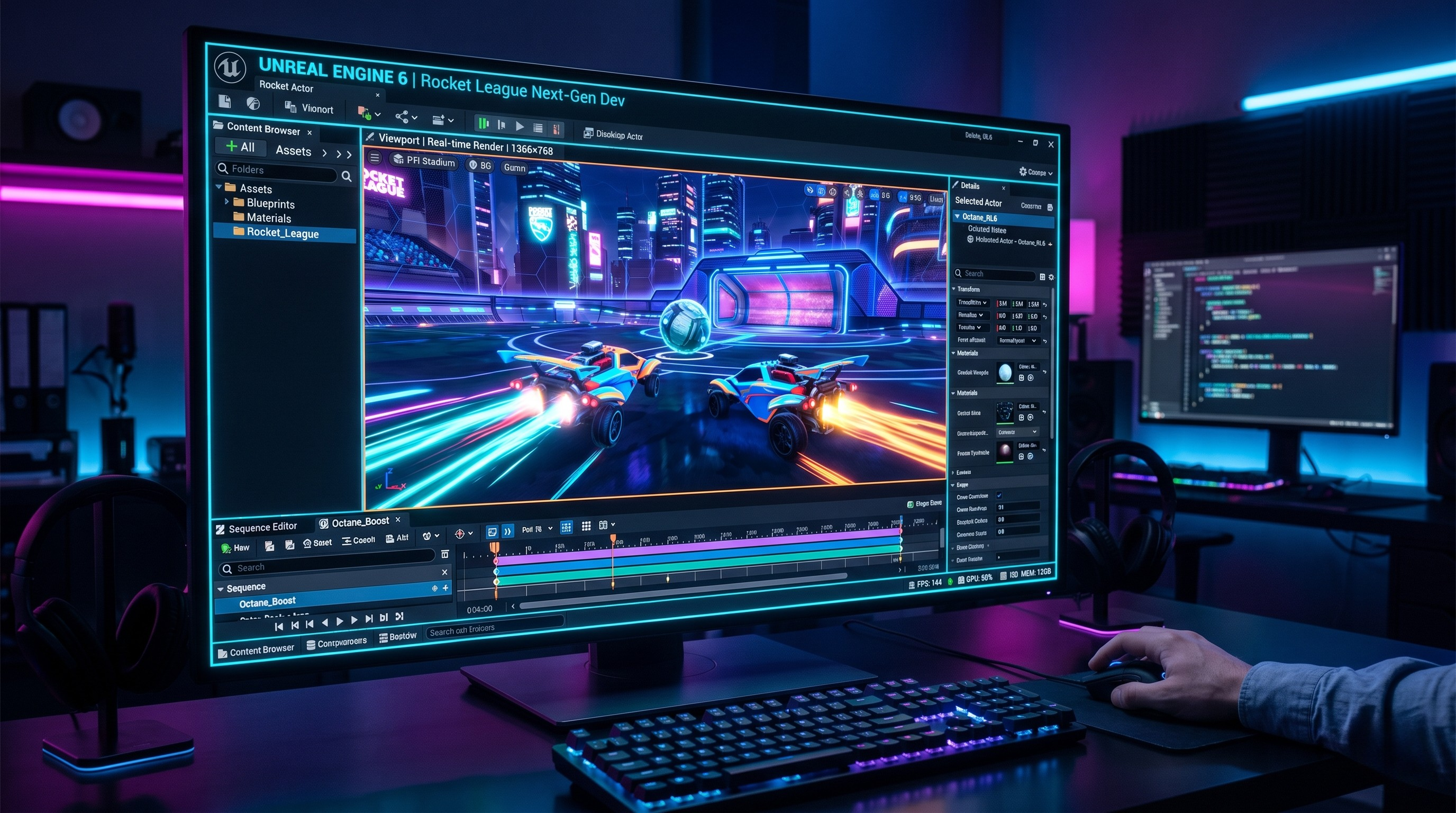
All of you who are into game development, creative games, and gaming in general, have some great news! If you keeping up-to-date within the gaming industry, you'll notice that something big is happening. Recently among the items dropped on Steam for Rocket League was a teaser trailer that left fans excited. But the real showstopper is that they announced the next generation of Rocket League will use Unreal Engine 6 (UE6).
That's right. For those of you who have been following Epic Games closely, and tinkering around with their software, have seen the version numbers continuing to climb. Right now we are at approximately 5.8 and not only have we not had an official announcement, there has also been complete silence on any word for what a 5.9 update will be. So, one can only conclude, we must be skipping the small steps in the version numbers, and jumping to Unreal Engine 6.
1. The Ultimate Combination: Unreal Engine and UEFN Merge
The next big development for UE6 is merging traditional Unreal Engine with UEFN, the Unreal Editor for Fortnite, which has already been developed by Epic Games as a means to allow players to mod, create, and give back to the Fortnite Universe. Originally created as a tool for players to create their own islands, game modes, and experiences, it has since evolved into an avenue for gamers to create whatever they desire, using exactly the tools Epic Games has provided.
Why merge a Fortnite modification tool with the most powerful professional game engine in existence? Epic Games knows that blockbuster games will no longer be created by the large development teams at major studios with thousands of employees, but will instead be created by each of you.
Epic is breaking down the barriers limiting the game development community by combining two platforms together (Unreal Engine and the Epic Games Store). Professional-level tools and an intuitive, highly collaborative environment will empower everyday individuals to create amazing games. If you can think of the ways YouTube changed video making, you can imagine how Epic will transform the way video games are made. Before YouTube, if you wanted to create a television show, you had to have access to a television network, a huge budget, and high priced equipment. Today, anyone with a smart phone and an idea can garner millions of viewers.
Epic is trying to accomplish the same thing in the video game market that was accomplished in the television industry through YouTube by creating a synergy between user-generated content (UGC) and modding with traditional, high-end video game development. This process to come to fruition will take a few years; however, we are just now at the beginning of what will be a very open and democratic gaming ecosystem.
2. Bye-Bye C++ and Blueprints, Welcome to "Verse"
If you have ever had the opportunity to develop a game using Unreal Engine, you know that Unreal has provided two primary methods for writing game logic, C++ and Blueprints. Over the past several years, developers have developed millions of lines of C++ code to make their vision a reality. The power of C++ can be amazing; however, it can also be very frustrating.
One of the largest frustrate points with using C++ for game development is the time it takes to compile code. When building a huge, complicated game, each time you make a change in your code, you must compile it in order to determine whether or not it works. Imagine you are baking a cake but realize that you need to add more sugar, and you need to bake another cake in order to taste how much better it is because of the new sugar. As a project grows in size, the compile times increase which ultimately slows down the overall creative process. Blueprints, Unreal's visual coding interface, assist with reducing compile times, but when a project scales up the limitations of Blueprints also accompany.
The Unreal Engine has had a major shift toward a whole new programming language named Verse. What makes this such a huge change? Well, for one thing, Verse is intended to be much faster and simpler than existing programming languages, especially for people who have never programmed before. This means that the bulk of the cumbersome and outdated syntax used in older programming languages is gone.
Another unique feature of Verse is that it allows developers to code "in real time." A developer can adjust the jump height for a character in a game, and they will see that change immediately without having to wait for a long loading time. This continuous stream of instant feedback is going to keep developers in the "zone" longer and make game development so much more enjoyable and efficient.
3. Greater Focus on Optimization
Next up is the third reason UE6 is shaking things up: optimization.
When UE5 was released, it came with incredible visual technologies like the Nanite system (which allows for incredibly complex geometry) and the Lumen system (which allows for hyper-realistic lighting). This made UE5 look incredibly nice and resulted in a rapid adoption of the engine. However, as more UE5 games began to be released, players began to notice a trend — many of the UE5 games were large and required high-end PCs to play smoothly, and many players using consoles experienced stuttering and dropped frames.
Epic Games lost some of its reputation at this point. The narrative around the UE5 engine began to change from "the world's most beautiful game engine" to "UE5-based games are unoptimized and choppy."
Epic is changing from using Unreal Engine 5.9 to a brand new engine, Unreal Engine 6 (UE6), in
response to a need for a narrative update. They want developers and gamers alike to know that they
have listened to the constructive criticism they have received about how Unreal Engine 5 has not been
performing well as anticipated, and have made a dramatic change to the engine's underlying
architecture (i.e., retooling it). While Unreal Engine versions 5.1 and 5.8 included incremental updates,
Unreal Engine 6 has made significant improvements in the speed, fluidity, and efficiency of games on
all platforms. Thus, Epic has demonstrated with UE6 that there doesn't have to be a trade-off between
frame rate and next-generation graphics.