.svg)
.svg)
 For Instructor
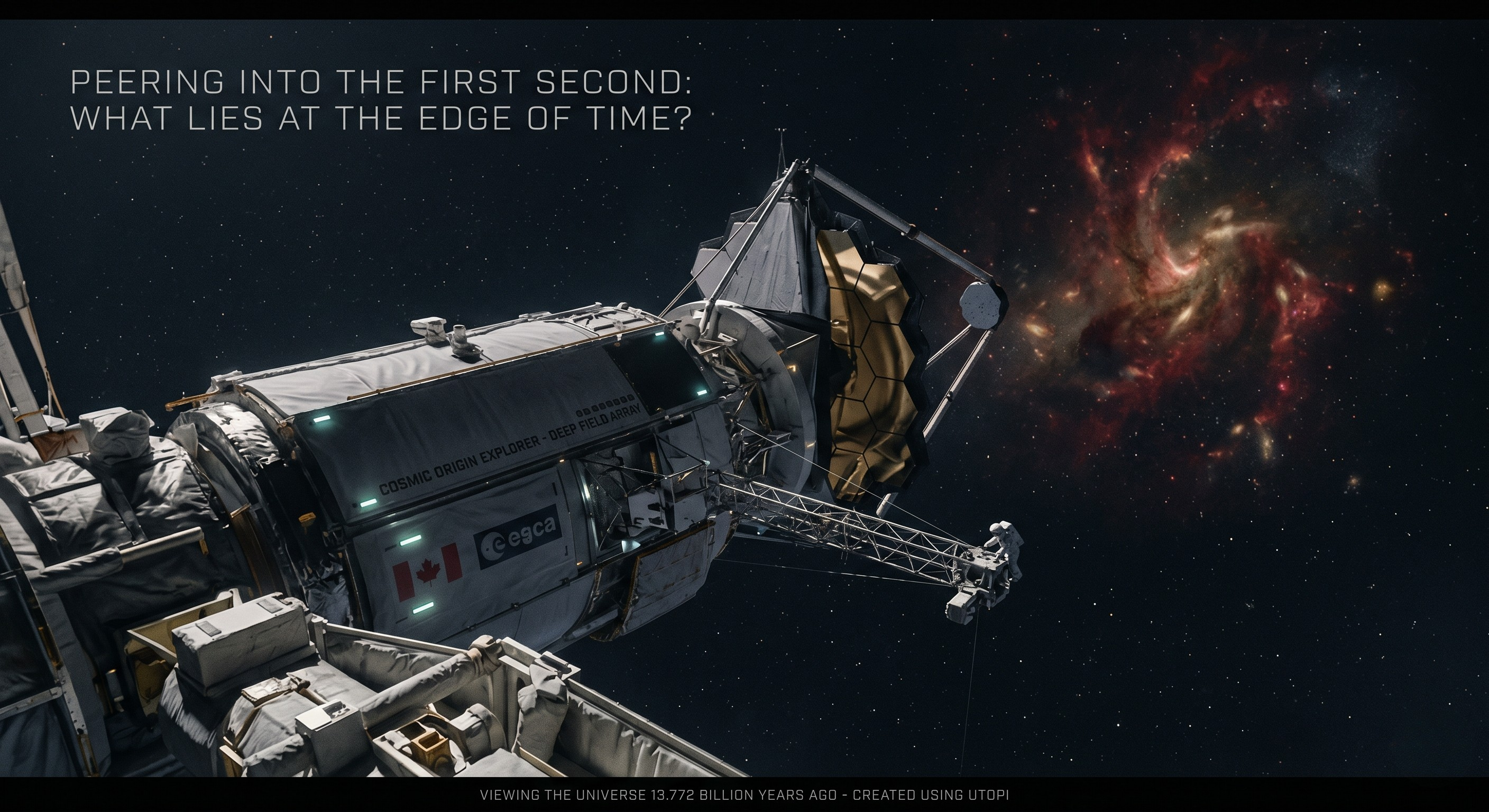
The phrase "When you look out into the universe, you are actually looking back in time," can be chilling. It’s an interesting fact that could be described as pure poetry from a science standpoint. However, when you consider the world of science fiction—especially with the new Utopi created trailer—this will form the basis of a potential mission that could transform everything we know about our existence.
Consider a world where there is an emergency and all communications with Earth have been cut off for whatever reason; all scientists are in their respective stations and working together to accomplish one goal, to build a powerful enough lens that they can see the first moment of the universe.
The essential questions are: At what distance do you have to look to see something "old"? And when we finally are able to see beyond the "cosmic fog", what will we then find? Let’s break down the incredible truth that lies within our fictional universe.
The Cosmic Time Machine
You must first grasp what light can do in order to comprehend the Inception Trailer. The light can move incredibly quickly; however, it will still take a while to reach you. Even at such high speed, it will take light 186,000 miles (300,000 kilometers) to reach you.
As shown in the trailer, the light you see from the Sun takes 8 minutes to reach Earth. It would take another 2 minutes after the Sun disappeared if it were to disappear now. We are therefore constantly looking back in time. This implies that any light we see from a galaxy 100 million light years away is from a time frame when the dinosaurs were still on Earth.
The main idea behind all of this is that in order for us to see the beginning of time and the universe, we need to look in the direction of the furthest and oldest light because the light that is now hitting the Earth is approximately 13 billion years old.
13.772 billion: The number that echoes time-worn truths.
Why 13.772 billion light years? That is our current best estimate for the age of the universe, or "known" time. Beyond that wall, there is no more light to be seen, for light has no time to get there.
In the trailer, the mission is building a telescope strong enough to slice through that "noise" and see the Origin itself. That is not a dream. That is the exact job that the James Webb Space Telescope (JWST) is doing right now. It looks through the clouds of dust with infrared, searching for some of the first stars and galaxies taking shape. But there again the trailer raises the bar. It asks the ultimate question: What is happening when we reach the "First Frame" in that movie of existence?
AI's Role in These Stories
How it was built shows a fundamental shift in how we explore massive concepts through Utopi. In the past if you wanted to do a trailer like this you would need a Hollywood studio, millions of dollars, and many years of VFX work. Today a creator has a vision and asks AI to show what the universe looks like created by an artificial intelligence.
Through AI we can prototype big ideas. We can see what a telescope looks like at kilometers in space, or the terrifying and beautiful "simulation" glitches forming in the universe at the edge of the Big Bang. AI is a tool for the "Let's find out" generation.