.svg)
.svg)

 For Instructor
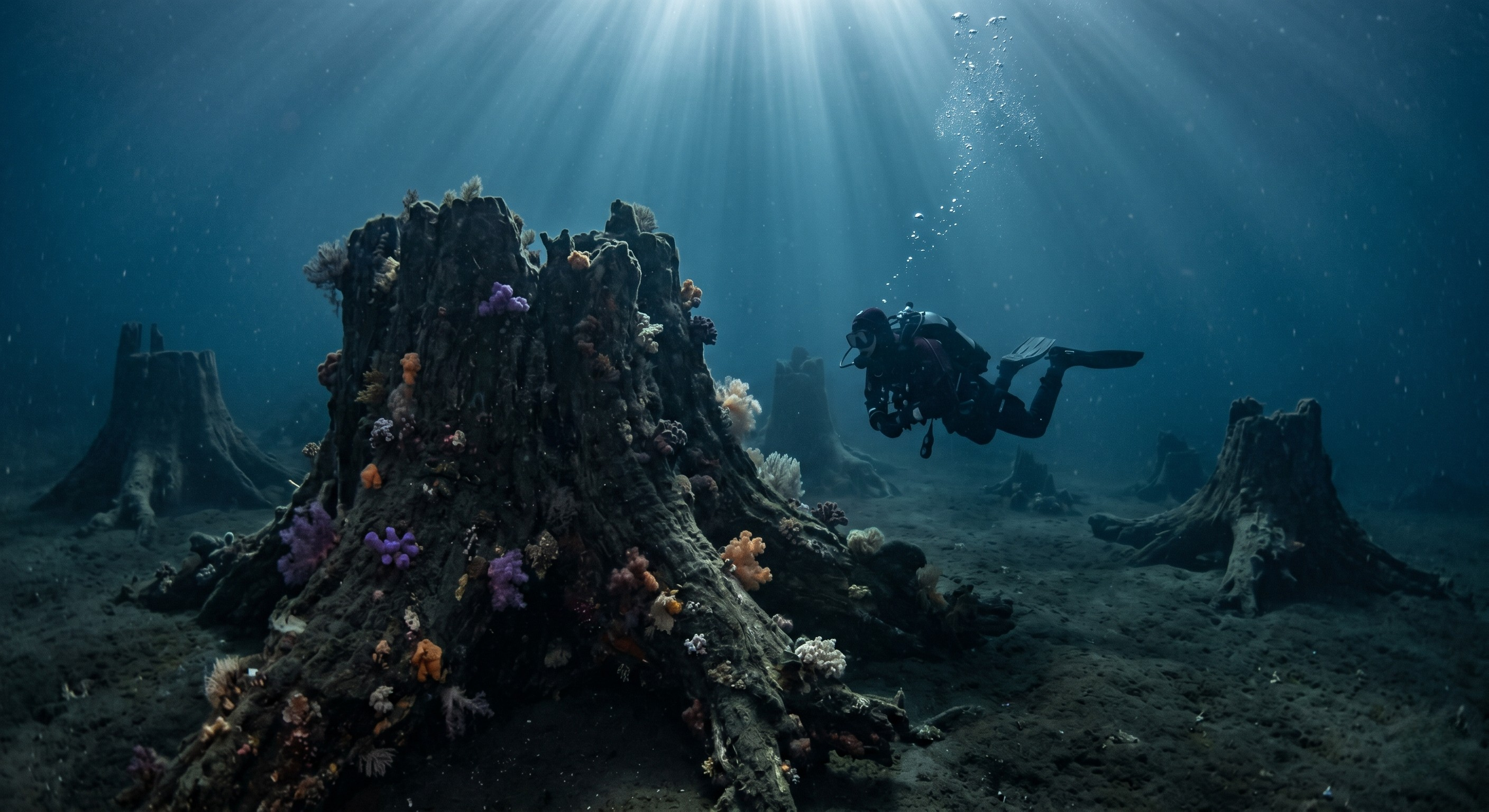
The Forest Beneath the Ocean: A 16,000-Year-Old Mystery
Have you ever stood on the beach of the North Sea and wondered how long it has looked like this: cold, gray, big, deep, and empty? What if I told you that there is something underneath it—the ocean floor; something that is not seaweed or kelp, but real, live trees—real oak trees or pine trees or hazel trees that have gone to sleep for a long time?
In recent months, a team of scientists have made an incredible discovery: they have uncovered what scientists call a "lost world" that is located "under" the ocean floor that is the remains of a prehistoric forest that is approximately 16,000 years old. This is both incredibly exciting and a sobering reminder of where we came from on the planet.
What Were They Able To Discover?
Over the years, many fishermen who have worked in the North Sea have routinely caught more than just fish. Occasionally they would catch something heavy and that something would turn out to be the remains of many different creatures—for example, some pieces of fossilized wood or the tusk of a woolly mammoth, to name just a couple examples.
With new technology to help map the ocean floors (such as seismic scanning—imagine an echocardiogram but for the Earth), scientists have now been able to get a better idea of how large the forest actually is. It is not only a few small trees that have fallen...
The Highlights of the Discovery:
: Tree Stumps that are Fossilized
The divers discovered tree stumps still going into the earth exactly where they were at 16,000 years ago.
: Seabed Peat
The absence of oxygen in seabed mud has acted like a time capsule for seeds, pollen, and even insect wings.
: Human Remains
Along with trees were also human remains found in the form of tools made of flint, which indicates this was not just a forest, but was also the home of someone.
Welcome to Dogger land; The European Atlantis
In order to understand how this forest ended up underwater, we must discuss Doggerland.During the last ice age when there were massive glaciers all over the earth; therefore, water was trapped within these glaciers and as a result sea levels were about 120 metres lower than they are now. Consequently, Britain was not an island but was attached to mainland Europe by the most tremendous; productive plain possible.Dogger land was called the "Garden of Eden" during the Mesolithic period; it had rolling hills; wide rivers; and large forests. Along with the great diversity of flora and fauna (mammoths; lions; deer) there were tribes of hunter-gatherers who lived in Dogger land according to the seasons.The time frame for this process was not instantaneous; however, in the bigger picture of Earth's history, it was quite quick. As the temperature on Earth became warmer and large ice sheets melted, global sea levels rose.The finding of the trees shows us when the “Great Squeeze” occurred. Over years of being inundated by water, all the lowland forests were converted into marshes, then into salt marshes, and finally, Doggerland was completely submerged under the North Sea. By approximately 8000 years ago, all that is left of Doggerland are parts of the “Dogger Bank” (a shallow sandbar) as a remnant of what was once a continent.
Along with trees were also human remains found in the form of tools made of flint, which indicates this was not just a forest, but was also the home of someone.
Welcome to Dogger land; The European Atlantis
In order to understand how this forest ended up underwater, we must discuss Doggerland.
During the last ice age when there were massive glaciers all over the earth; therefore, water was trapped within these glaciers and as a result sea levels were about 120 metres lower than they are now. Consequently, Britain was not an island but was attached to mainland Europe by the most tremendous; productive plain possible.
Dogger land was called the "Garden of Eden" during the Mesolithic period; it had rolling hills; wide rivers; and large forests. Along with the great diversity of flora and fauna (mammoths; lions; deer) there were tribes of hunter-gatherers who lived in Dogger land according to the seasons.
The time frame for this process was not instantaneous; however, in the bigger picture of Earth's history, it was quite quick. As the temperature on Earth became warmer and large ice sheets melted, global sea levels rose.
The finding of the trees shows us when the “Great Squeeze” occurred. Over years of being inundated by water, all the lowland forests were converted into marshes, then into salt marshes, and finally, Doggerland was completely submerged under the North Sea. By approximately 8000 years ago, all that is left of Doggerland are parts of the “Dogger Bank” (a shallow sandbar) as a remnant of what was once a continent.
What is the significance of our investigation into submerged trees in the North Sea? This ancient forest reminds us of the Earth's history through the warning signs of climate change.
First: To learn about climate change, researchers can reconstruct how the climate changed 16,000 years ago by examining the layers of peat and trees in this ancient forest. These reconstructions can give us insight into the rate of sea level rise. The world has already experienced sea level changes, and the Dogger land example provides further evidence of how much land the oceans can reclaim.
Secondly: Finding the submerged trees also shows that the Earth has changed dramatically over time. The North Sea was not always a cold shipping lane; this ocean was once part of the green landscape of Europe. The findings teach us that plants, animals, and humans will adapt when their environment literally sinks.
Finally: Archaeology was traditionally thought to only occur on land, but the discovery of submerged trees indicates that we have a new field of archaeology called "Continental Shelf Prehistoric Archaeology." Our planet has countless square miles of submerged land that we have yet to explore.