.svg)
.svg)
 For Instructor
You’ve probably been in the position before, you have a large gap in your bill budget for the month. You find out there is a warehouse grocery store near you that sells your favourite coffee at 50% off. `For a short while you’ll feel like a genius; you’ll have a run on that coffee, a savings account and life is good!
For the last number of years India has been experiencing this same phenomenon just on a much larger international scale. Russia was our warehouse grocery store and oil was the product!
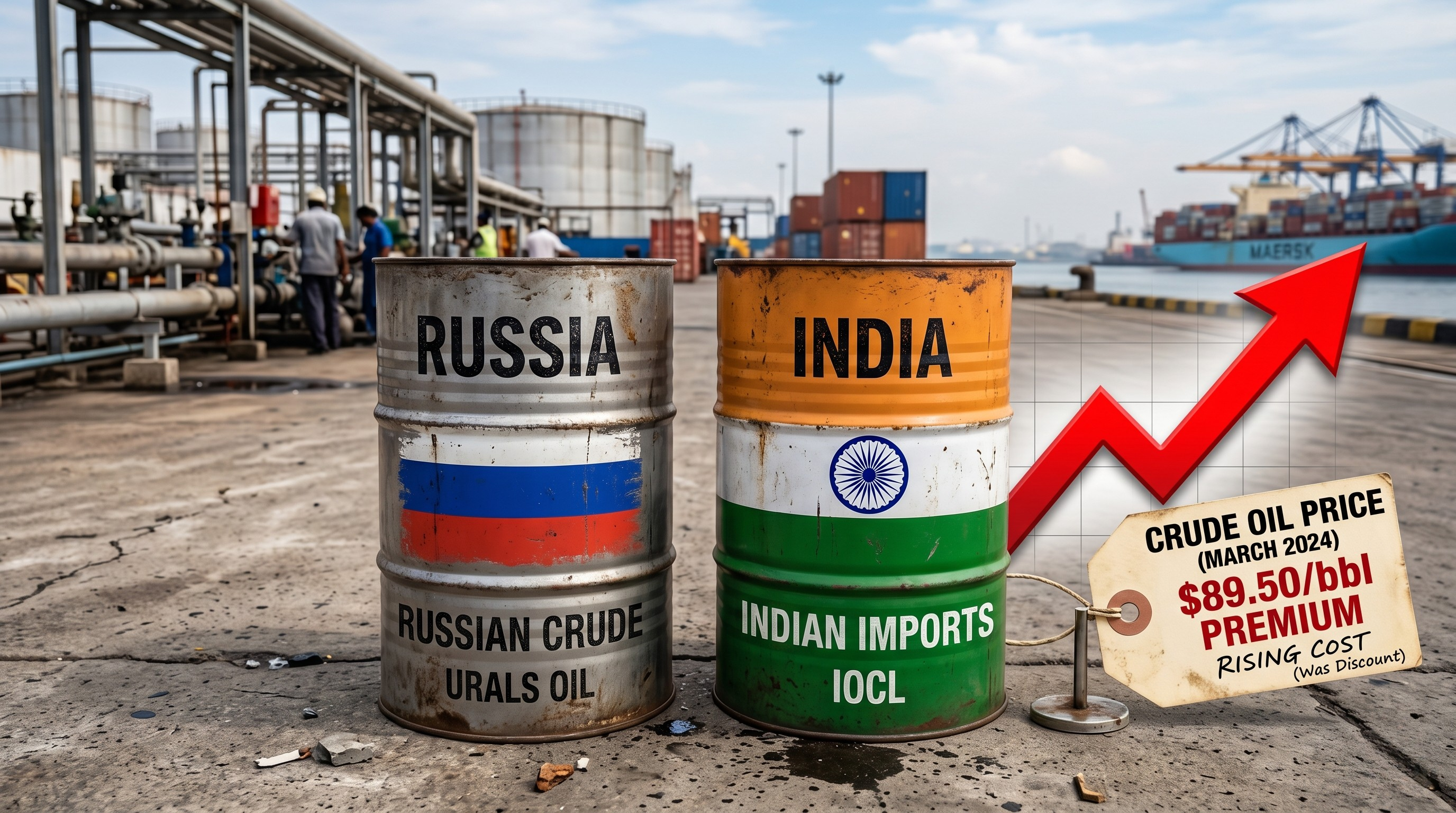
We have seen the headlines of how over the last two years India has been able to buy Russian crude oil at very low prices. It was very astute economic policy! But fast forward to now, March this year and the story has changed completely. Russia has increased its share of Indian oil imports, but the great rates we have enjoyed all along are gone, they have now turned into crazy amounts for oil!
That's correct. We paid more for the product than if we were to have purchased it at the old price.
How did a buyer’s market become a seller’s market? How could anyone buy more when the cost was higher? In order to answer these questions and to understand what happened, we need to look beyond Russia, and instead leave the Kremlin behind us and focus on the chaos and conflicts that are occurring throughout West Asia.
So grab a drink and get ready for a challenging and exciting ride through the complicated, high-stakes area of global oil economics.
The period of time known as the "Russian Discount" is often referred to as the "Golden Era."
To grasp the significance of March's dramatic price increase, we must first examine how the price was at such a reduced rate.
India, as the world's third largest consumer of crude oil and importer of crude oil products, imports over eighty percent of its oil needs. India heavily relies on Gulf nations for its daily supply of crude oil to power the nation’s cars, to manufacture various products in factories, and to provide electrical energy to homes. Prior to 2022, crude oil imports from Russia accounted for less than two percent of the country’s total crude oil imports, simply because the cost of exporting crude oil from Russian ports to Indian port was much higher than the cost of transporting crude oil from West Asian ports to Indian port.
However, on account of the evolving geopolitical landscape, this all changed. After the first half of 2022, the geopolitical situation regarding Russia became quite different and resulted in western nations implementing multiple layers of sanctions against Russia as a result of Russia’s invasion of Ukraine. Consequently, Russia (previously having Russia as a major client) no longer had Europe as a primary client, and thus Russia was left with millions of barrels of crude oil but no one to sell it to. At the same moment, India was in need of massive and expanding amounts of crude oil for the continuing and rapid growth of its economy, which created the conditions necessary for this very attractive arrangement. Russia began offering oil to India at considerable discounts of between twenty and thirty dollars (and even greater) per barrel than market.
In 2022, Indian refiners jumped on the opportunity to acquire significant amounts of Russian oil. The result is that by January 2023, Russia was now supplying almost 40% of India's total crude oil imports. As a result, India's economy was able to absorb the impact of higher global energy prices as a result of inexpensive Russian crude, thus keeping inflation low while other countries were experiencing record high energy costs. In summation, this has been very beneficial to both countries.
March Madness: The Plot Twist
Let’s jump ahead to March. After the data arrived, analysts had to do a double take. Thus far, it was reported that Russia's percentage of our import oil supply had increased massively. Importers were, in essence, filling up their tanks at Russian supplier refineries. But then when you looked at the invoices, the purchase price for these oil shipments when they arrived in India did not look the same.
The Russian supplier’s discounts were gone, and in many cases Indian oil importers were purchasing oil at higher prices than their respective prices from other suppliers with similar grades of oil.
Think about it this way. Suppose you and your buddy go to a distant grocery store to purchase coffee. When you arrive though, you find that the grocery store changed the price of their coffee so high that you could get your buddy the same sized cup of coffee at a comparable price at the local café. Why did Indian oil importers choose to do that?
The Cause of the Current Events in West Asia
The answer does not come from Moscow or New Delhi, but from the area between the Red Sea and Gulf of Aden.
West Asia (Middle East) has been in turmoil since late 2023 with the Israel-Hamas war. After the conflict began, there was an increase in attacks on commercial shipping vessels in the Red Sea from the Iran-backed Houthi rebels in Yemen.
So why does this matter? Because the Red Sea is the only access point to the Suez Canal—the most important shipping lane for global commerce, whether goods (or oil) are shipped between Europe, West Asia, or Asia.
Suddenly, this very important passage became a war zone, with missiles firing and cargo vessels being attacked. Insurance companies went into a full-blown panic. The cost of insuring a tanker passing through the Red Sea skyrocketed to levels never before seen.
As a result of the danger posed to their crews and the value of their cargoes (in the tens of millions), significant shipping companies and suppliers of oil made the choice to entirely avoid the Red Sea.
The Long Way Around
When you do not have access through the Suez Canal to travel from West to East, what options do you have? You can either navigate all the way down the west coast of Africa, sail around the Cape of Good Hope, and then navigate yourself back up through the Indian Ocean.
This detour is quite large and adds an extensive distance onto the journey, taking 10-15 additional days each way.
Let's assess the impact on oil prices due to this detour:
Increased quantities of fuel: A ship that has to sail for an additional two weeks, uses up an enormous amount of fuel.
Increased charter time / costs: Due to long transit times, you will also have to rent the ship for a longer period of time and pay the crew for more days.
Shipping shortages / high charter costs: Because it takes longer to complete one single voyage on board a ship, there are fewer ships available worldwide to transport products. This results in increased daily rental costs for oil tankers.
How the Supplies to India From the Gulf Have Been Impacted
The question remains how this impacts relations between India and Russia.
In the past, whenever India has had an urgent need for oil, or the cost of Russian crude became too high, refiners could quickly turn to their long-time trading partners in West Asia, including the Kingdom of Saudi Arabia, the Republic of Iraq or the United Arab Emirates. It was an easy and reliable option due to the relatively short shipping distance from the organizations in question and the fact that they were supplied regularly by these organizations.
The crisis in West Asia placed a major disruption in this trade pattern, causing a high degree of difficulty securing and shipping oil through the greater Middle East due to the extremely high freight and insurance costs associated with that region at the time. As a result of this, the period on the cargoes from that region was also impacted by the delays; therefore, the spot market for crude oil from West Asia became extremely competitive and expensive.
A Problem and Solution
In addition to putting pressure on refiners through funding to lower their costs, the Indian government also put pressure on refiners to stop importing Russian crude oil because of the crisis in the Middle East. With all these pressures working against them, Indian refiners really struggled in the last quarter of 2014.
Apprehension and oil prices kept refiners from being able to buy enough crude oil to keep their operations going. Therefore, to ensure continued production, Indian refiners looked to Russia as the last viable supplier to support their production needs.
The global oil markets are experiencing a significant amount of change and instability due to geopolitical issues, such as the crisis in the Middle East and rising tensions in Europe. As suppliers from the Gulf Gulf region begin to move from an over-supply situation to an under-supply situation, Indian refiners who were previously able to buy crude oil at discount prices are now faced with securing their supply at much higher prices.
The Squeeze also discusses how this situation will adversely affect refinance and cash flow as refiners attempt to raise capital to fund their operations while simultaneously attempting to secure additional supplies (crude oil) to continue to operate their businesses going forward. This article will provide an update on the current situation when you return next Friday.
When your customer's alternatives are eliminated, all of a sudden you will have tremendous leverage over them in the negotiation process.
For instance, Russian suppliers simply said: "Sure, we will help you increase your supply of oil, but due to today's very high shipping costs, and your need for our oil, we are no longer providing you with $20 off of your purchase. In fact, due to the prohibitive costs of shipping oil to your ports, we'll have to charge you more than the current market price for oil."
Consequently, Indian refiners were forced to accept this premium in order to ensure their ability to operate (keep the lights on as well as fuel their vehicles). As a result, while they secured their supply of oil to avoid a fuel shortage in India, they had to incur the increased cost of purchasing the necessary oil.
How will this affect me?
You may be asking yourself, "This seems like very interesting worldwide economics, but what does it mean in my day-to-day life?"
The cost of crude oil is the pulse of the globe's economy. When it goes up, everything follows suit.
1. The Cost to Fill Up At The Pump Will Go Up:
One way that this will directly impact you is by the amount you pay at the pump for petrol or diesel. In India, the government will usually step in and help to maintain stable prices to a degree (at least around elections), but if there are extended periods where crude oil is selling at higher than normal prices, then eventually you will pay the same premiums at the pump to fill up your car.
2. Cost of Goods (Inflation):
Everything you purchase, from the produce in the local grocery store to the cell phone that you are holding, must be transported to your home. All freight trucks run on diesel and if the price of diesel goes up due to refiners paying a premium for purchasing Russian crude oil, then the transportation companies will pass along these additional costs to farmers, manufacturers and retailers that will ultimately be transferred to the consumer. This explains how an increase in the price of oil would create a rise in Overall Inflation.
3. Macro Economy:
In India, when purchasing crude oil from other countries, we are required to pay for those imports using a foreign currency, primarily the US Dollar. Therefore, with the price at which we pay for crude oil increasing, more dollars are being sent out of India, which is causing the Current Account Deficit to widen which puts upward pressure on the Indian Rupee (causing it to depreciate), which makes all of our other imported goods more expensive, causing Overall Inflation to continue to rise.
In light of recent world events, energy security is often seen as tenuous.
In the last two years, we have been getting a discount on Russian oil and thought that this would be the norm moving forward. However, with the West Asia crisis, we were reminded that in the interconnected world of global trade, one conflict can wipe out any competitive advantage you may have had thousands of miles away.
This illustrates just how skillfully, and precariously, India must navigate the global political tightrope. As a developing nation, India needs inexpensive energy to lift millions out of poverty and build its industry. Thus, we cannot take sides, so India has managed to maintain its neutrality and buy oil at whatever is offered at the best price.
What's Next: Potential Solutions
So is there really no way for India to avoid continuing to suffer from the vicissitudes of international politics, along with the impact of volatility in crude oil prices forever? Not quite. The events of March have accelerated dialogue around three major strategies for India:
Diversification: India cannot depend solely on Russia and the Middle East for crude oil supply, so the country is looking to broaden its sourcing options. This means actively pursuing new suppliers in West African nations, South American countries and in the U.S.. The more suppliers being sourced from, then the lower the demand for any one supplier increases.
Strategic Reserves: In addition to diversifying, India is also working to build larger Strategic Petroleum Reserves (SPR) (huge underground storage caverns of crude oil) to provide the country with an emergency buffer which may be accessed when there is a major crisis causing substantial increases in crude oil prices, instead of having to purchase crude oil at a premium price.
Green Transition: Ultimately, if India is to truly escape the rollercoaster of volatile world crude oil prices, it must eliminate its dependence on crude oil altogether. The events of the past six months have created unprecedented urgency behind India's efforts toward electric vehicles (EVs), solar energy, green hydrogen and biofuels.