.svg)
.svg)
 For Instructor
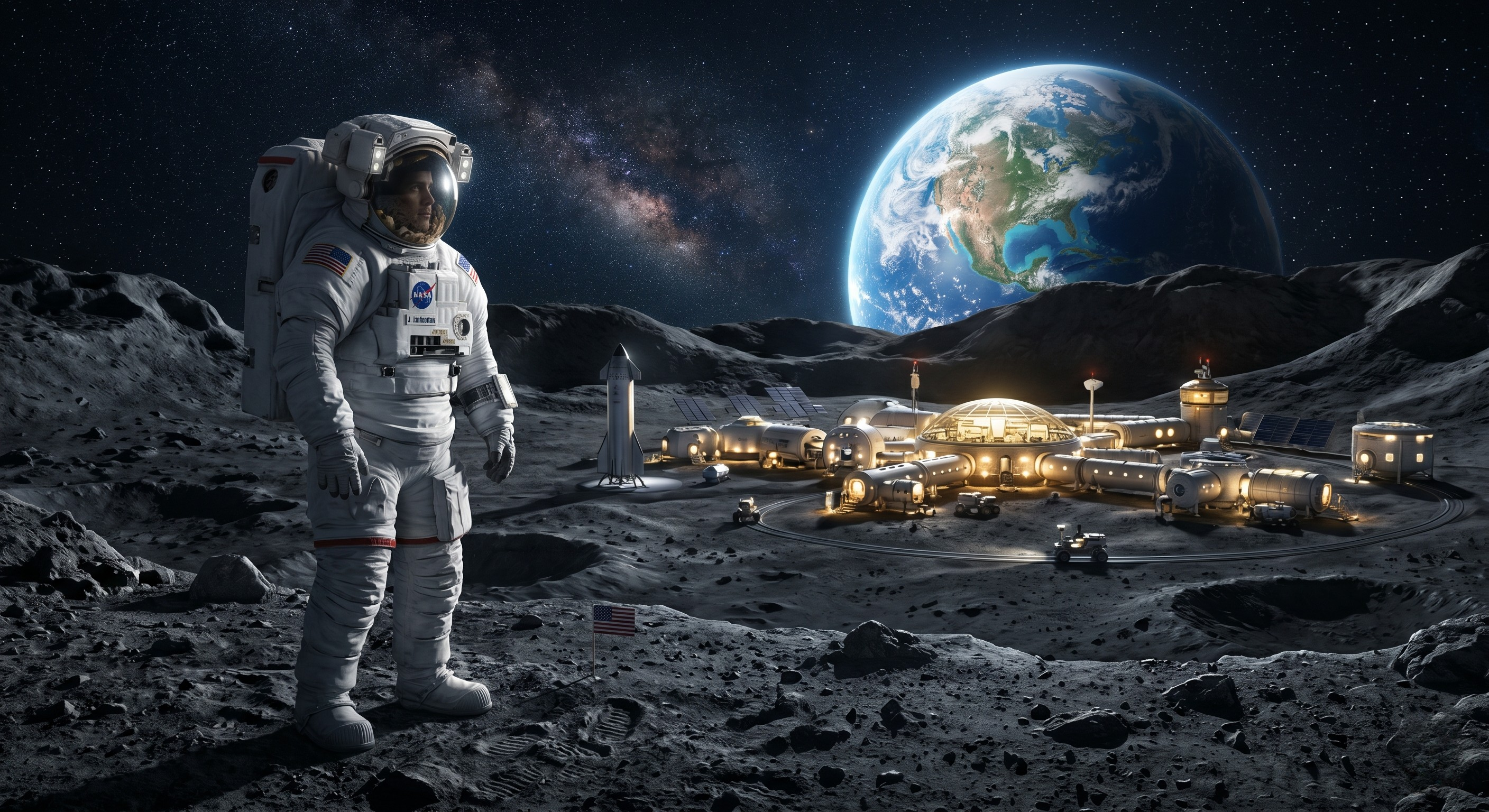
Have you ever looked up at the sky at night and thought, When is humanity going back to the moon? Well, you can stop wondering, go put on your space suit, and get your calendar ready because we now have a solid plan.
Recently, NASA Administrator Jared Isaacman went before the House Committee on Science to present the future of U.S. space exploration as it continues to be aggressively pursued by its own government and private industry. The Governor delivered an exciting, clear message about how this new plan will focus on three main areas that will dominate the next decade of space travel.
These are not just abstract ideas. They are concrete and specific goals set forth by NASA to ensure that the United States remains competitive in the increasingly competitive global race towards the stars.
Below is a breakdown of what NASA's new plan entails, what this means for the future of U.S. space exploration, and how significant budget challenges may impede this plan from coming to fruition.
Priority1: Return to the Moon By 2028
It has been over four decades since we last had boots on the moon — the Apollo 17 mission in 1972. How many people today can say they have gone to the moon or that grew up with any kind of reference to walking on the moon? Fortunately, NASA is shifting gears and will do so quickly.
Those words were said by Isaacman in reference to the “top task” directive from the current administration: “Return to the moon, increase launch cadence, and land American astronauts on the surface of the moon by 2028”.
The Artemis program is the major initiative to return astronauts to the moon with the first mission, Artemis II, likely being one of its most visible. This mission succeeded in demonstrating the capabilities of the NASA agency when everything ran smoothly. While it did prove that astronauts could be launched around the moon and then safely returned home, the real takeaway from this mission was what Isaacman said to lawmakers: “We showed the world the moon again, and we showed humanity Earth again.” The importance of the 2028 goal is not only about being nostalgic, and planting another flag in the grey dust, but also about increasing our launch cadence (which is an industry term for how often we launch). As indicated during the Artemis II mission, long delays between mission launches completely hampered our ability to move forward as a society.
NASA’s Priority 2: Sustaining a Lunar Base
NASA’s goal has changed from one of “flags and footprints” to one of building a long-term, permanent presence on the Moon. According to Isaacman, the agency has developed new strategies for establishing that presence in partnership with private industry and other government organizations.
What does a Moon base mean? More than just a small canister placed in a crater. A sustained human presence on the Moon requires extremely developed infrastructure. This includes:
1. Advanced Landers that can safely transport cargo and people between lunar orbit and the surface of the Moon.
2. Pressurized Rovers that function as mobile habitats to allow astronauts to travel on the Moon for days or weeks without having to wear bulky space suits while inside.
3. Power Systems to power a base for 14 days of extreme cold each lunar cycle, including solar and advanced nuclear power sources.
4. Communications Technologies to provide high-speed connectivity to the Earth for both scientific data exchange and to keep the crews connected.
The enduring human presence on the Moon offers a critical platform for future options. By establishing permanent human presence(s) (mine for water, build shelter, etc.) on the Moon, those same capabilities will also assist us in sending humans to Mars.
Priority3: Increased commercial space
The transition to a commercial space economy as part of NASA's new strategy is one of the most fundamental changes occurring at NASA. The introduction of the commercial space economy marks a major transformation in how NASA operates and what it will do in the future.
Traditionally, NASA has designed, manufactured, and owned everything it launched. In the future, as stated by Isaacman, NASA plans to purchase services from industry rather than conduct its own development. Further, Isaacman intends to work cooperatively with industry to develop additional astronaut payload opportunities as well as additional monetization opportunities from astronauts flying to low Earth orbit.
How does this work in actuality?
Commercial Space Stations: The International Space Station is reaching the end of its lifetime and will be decommissioned at some point in the future. NASA's plan is to require commercial entities to operate private space stations in lower Earth orbit rather than to spend billions of dollars to create a replacement for the I.S.S.
Satellite Deployment: NASA will outsource the routine functions required to “deliver” satellites to commercial companies.
Capitalization: NASA is working to create revenue opportunities for commercial endeavors in outer space such as zero-gravity manufacturing, space tourism and/or research.
Through outsourcing of routine work in lower Earth Orbit to the commercial sector, NASA can devote its talent and budget dollars to really tough problems such as deep space exploration, develop nuclear propulsion systems and expand the limits of human knowledge.
Budget Cuts - The Elephant Within the Room
All of the items we have discussed thus far may sound like science fiction fantasy for the die-hard Sci-Fi Fan but as the members of Congress were having the House Science committee meeting, the elephant within the room was addressed halfway through the meeting when the issue of Budget cuts came up.
According to NASA's budget proposal for the FY2024 budget, it proposes to cut NASA's budget by 23% from the last fiscal year.
Rocket Scientists do not need to be born with 20/20 vision to tell you that it seems to be an impossible task with an astronomical reduction in funding.
Members of Congress have expressed their bipartisan concerns regarding the issues of building a Moonbase, more frequently launching into space, and establishing capabilities to develop new technologies for deep space exploration with approximately 23% less funding for NASA than they had last year.
Global Competition Poses a Threat
Chairman Brian Babin of the Space Subcommittee has sounded an alarm bell about the need to protect national security and global competitiveness from our competitors around the globe. There is no longer one superpower: The US is not the only superpower looking to reach the Moon. China is making advances at an unprecedented pace, from rover launches on the far side of the Moon, to human expedition plans on the Moon.
"In the end, NASA must be adequately funded," Babin warned. If we "shortchange" NASA's funding today, we risk our international position as the pre-eminent leader in outer space from our enemies.
Zoe Lofgren, the Ranking Member of the House Committee on Science, Space and Technology, took a different approach when she attacked the proposed budget cuts to NASA's budget. She stated that NASA does much more than only shooting rockets at the Moon; NASA is also engaged in monitoring climate change, studying the universe using the James Webb Space Telescope, and developing new aviation technologies.
Lofgren further indicated that a cut to the Moon program will financially impact certain programs much worse than others. For instance, if the cuts to the Moon program occur, Earth science programs will experience a disproportionately greater reduction to their budgets, and so will aeronautics research and technological development. "That's not a winning strategy," indicated Lofgren.
Other members of Congress also shared similar concerns; they expressed concerns regarding the impact on NASA's workforce. If the private sector continues to create jobs, the best engineers from NASA will be lost to the private sector, and, ultimately, NASA will become too reliant on commercial providers whose focus will be on profit rather than scientific discoveries.
Isaacman's response to budget criticism: maximise output from less funding
Administrator Isaacman, under the intense scrutiny of budget critics, withstood pressure to change course on the agency’s budget and remain solidly committed, throughout the entire conversation, and to “always follow the law” in spending federal appropriated dollar – including complete and total transparency (to Congress).
But he presented a larger cultural shift in how NASA accomplishes its work. Isaacman explained the 23% cut in funding will not be the death of the Artemis program, but rather an opportunity to cull unnecessary expenses and eliminate inefficient programs.
He also referenced a history of NASA’s large-scale projects that have consistently experienced excessive budgets and extreme delays. In the future, NASA will move away from large-dollar and large-scale development programs to a portfolio of focused investments with an expected return on investment and productivity.
“I don’t believe that we can establish programmes that are designed to be so large that they cannot fail, but at the same time so expensive that it would cost too much to succeed,” stated Isaacman.
Isaacman's ultimate vision is to create a “lean and mean” NASA; one that focuses specifically on outcome-based performance rather than simply throwing money at problems. If an internal programme isn’t producing results, it will be cut; and if a private sector company can perform it cheaper and faster than NASA, then that company will be utilized.