.svg)
.svg)
 For Instructor
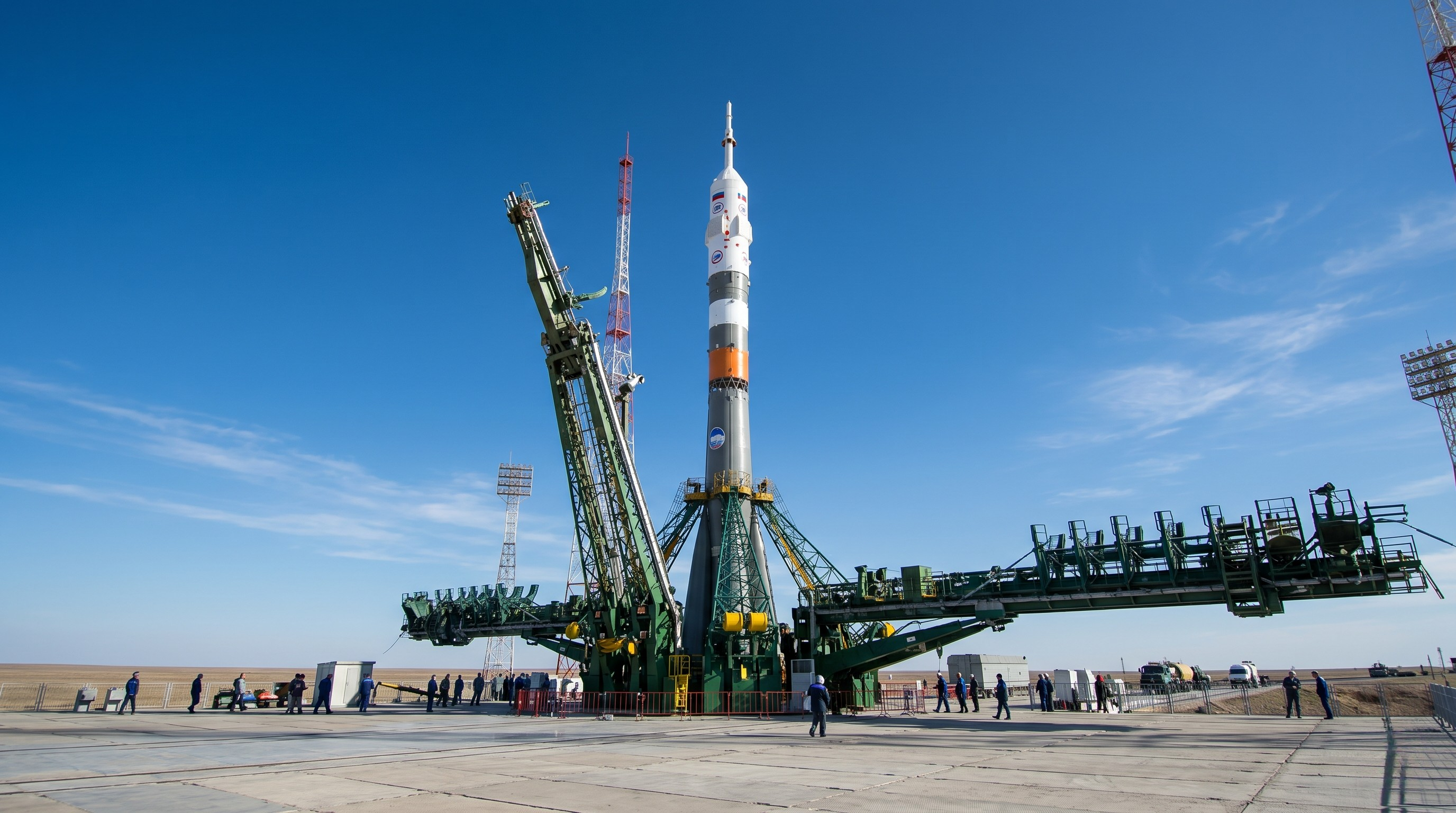
Hello fellow space lovers! Have you ever wondered how astronauts survive in such an inhospitable environment like space so far above the surface of our planet? Well, if this was something you were curious about, then today is your lucky day! Imagine living in a house that is really high-tech and also traveling 17,500 MPH! Now imagine if you were talking about everything you needed to keep you alive (Air, Water, Snacks, Fuel etc.) being delivered there by a rocket.
Well, that is exactly what is happening today (April 26th) at the Baikonur Cosmodrome in Kazakhstan. Today at Baikonur, the Progress MS-34 cargo craft is fully prepared for a huge delivery of supplies to the crew onboard the International Space Station (ISS). The Progress MS-34 cargo craft has already been mated (strapped together) with an Soyuz-2.1 rocket and will launch from Site 31 at the Cosmodrome to rendezvous with the ISS.
The official launch time for the Progress MS-34 cargo craft is 5:00 PM Astana time. This will not only be a simple Fed Ex delivery, but also an incredible display of orbital mechanics, engineering and logistics at work! Let’s take an in-depth look at exactly what is happening with this rocket launch today, as well as what is inside of the ‘trunk’ of this spacecraft, and what makes missions like these the lifeblood of our human race in space.
the possibility of error.
Now, it is time to launch the Soyuz rocket and its massive payload into space. Once the payload is placed on top of the rocket, the payload is connected to the fuel tank. From this moment on, the two (rocket and payload) will be flying together as if they were one single unit.
With the completion of today's scheduled activities for the Soyuz-2.1a rocket, the transition process from Earth to the International Space Station can begin. And once it begins, nothing will be able to halt its progress toward orbital flight. The climb to the ISS will be relatively quick—within four hours of launch. At an altitude of 510 km (320 mi) above the surface of the Earth, the Soyuz rocket will release its payload, which will then enter its own trajectory for docking with the ISS between 200-250 km (125-156 mi) from the Earth's surface.
As you can see, this is an exciting time for the Russian space program. For those of you who have watched any of the Soviet Union’s early launches in the past, just wait until April 23, 2001, for the first of two upcoming launches (and not just to see the latest model rocket). Thousands of people will gather at Site 31 in Baikonur to witness another "first." The future of human spaceflight will be demonstrated with the launch of the Soyuz-2.1a, and the cargo that it will carry to the ISS marks the next step on the road toward manned lunar missions.
In summary, we have arrived at the end of the introductory information for the Soyuz-2.1a rocket and will now move to the specifics (FAQs) for today's launch!
What to Bring on a Trip to the ISS: Items Needed for a Space Mission
What should you bring when travelling to the International Space Station (ISS)? You will want to include some of everything in your luggage.
The Progress MS-34 is carrying over 2,500 kg (more than 5,500 lbs) of cargo. This is the equivalent of an average weight of an oversized van, only the vehicle being used is a small I truck with all of those weighed down items in a very close proximity to the end of the truck, which you can see when the shipment of goods arrives.
Every gram of this total weight has been very carefully calculated, as it would cost thousands of dollars (even more if it goes beyond the first 1,000 lbs) to ship 1 lb of anything to a low cost, low quantity of goods to orbit; thus making it impossible to send junk. Below is a complete list of what has left Earth for today’s orbit:
1. Replenishing Propellant:
Much of that mass consists of fuel. The International Space Station (ISS) is orbiting in low-elevation orbit (LEO). In a vacuum (space), there are still/always some atmospheric forces acting on the ISS; however, these forces are very small compared to the rest of the universe/space. Because of these atmospheric forces, the ISS will lose speed and eventually de-orbit (fall to Earth), unless something is done about it. The ISS boosts itself to a higher altitude or elevation every few years with the Progress resupply ships bringing fuel so that its reaction control thrusters can do this critical maneuver.
2. What You Need: Water and Air
On Earth, it is easy to forget how precious each are; however, in space, they are not. The ISS can recycle a large amount of its water - as you will see soon enough, your coffee today can be re produced for your coffee tomorrow - but there are still some losses. Progress MS-34 will be delivering fresh drinking water to the ISS to replenish its supply.
It also produces oxygen. The oxygen that is usually produced on Station-generated oxygen is generated through a process called electrolysis (splitting water into oxygen and hydrogen) but also has back-up tanks filled with pressurized oxygen that are required for safety. There can be no such thing as too much breathable air when you live in a vacuum.
3. Sanitary & Hygienic Products
Life in space has its ups and downs! Astronauts undergo daily rigors in performing their duties which involve working out (2 hours per day) so they lose neither muscle nor bone as a result of living weightlessly; as such, they also generate some level of perspiration. Additionally, because there are no washing machines or regular showers available onboard, astronauts have to rely upon wet wipes and special no-rinse type of shampoo for personal hygiene. For dry personal cleanliness, both towels and undergarments are required by all astronauts on the ISS. When clothing becomes too dirty, it cannot be cleaned, but rather, it is placed onto a resupply vehicle to be destroyed upon reentry into Earth's atmosphere.
Menu Overview: Food That You Can Eat in a Space Environment.
According to Ros cosmos Press Release, over 483 kg (over 1,000 pounds) of the total cargo is space food for the crew of the International Space Station (ISS). Food for Astronauts or cosmonauts has evolved dramatically since the days of the Apollo program. In the past, astronauts had to squeeze meat puree from a tube like toothpaste to eat it, but today astronauts enjoy a wonderful dining experience through new methods of preparing space food.
We are going to go through the list of space foods, however, first let’s take one step back to see how the food is prepared. Think about how you would eat a crumb of biscuit floating around in microgravity; the biscuit would float all around you and possibly get into your lungs or short out a multi-million dollar computer panel! For this reason, specific requirements have been developed for space food:
: No Crumbs
Tortillas are much more desirable than bread since they will not leave crumbs upon eating.
: Sticky Foods are Good
Sauces are very helpful because the surface tension allows the food to remain on the spoon while eating.
: Dehydration
Water is heavy. To reduce weight on spacecraft, most food is freeze-dried on Earth. When a crew member wants to eat a meal, he simply attaches the food pouch to the water dispenser on the spacecraft, waits a few minutes and eats!
Morale is just as important as gaining weight; this 483 kg food package is more than just calories! Six months of confinement in space away from your friends and family can take a toll on you both physically and psychologically. Receiving a good meal, for example, the fresh fruit delivered by a cargo ship, can make the crew happy. The holidays/birthdays on the ISS are celebrated by sharing any special food packages that were delivered by missions similar to this.
The Orlan ISS Spacesuit No. 8 is a brand new spacesuit hitching a ride on Progress MS-34.
Astronauts utilize these orbiting spacecraft as their suits when they leave the station for an EVA (extravehicular activity) to work on or install equipment. These spacesuits are more than just suits; they are mini-spaceships designed to keep an astronaut alive and functioning while outside the ISS.
Spacesuits provide astronauts with an adequate supply of oxygen, regulate their body temperature (the temperature in space can vary from 250 to -250F), protect astronauts from micrometeoroids, and provide astronauts with a way to remove carbon dioxide from the suit.
The Orlan suit is used by the Russian cosmonauts as their primary space suit, and it has a distinct design. Unlike the American EMU space suits, which consist of multiple parts (pants, hard upper torso, helmet) built together by the astronaut before starting an EVA, the Orlan suit is made of one rigid piece of material, similar to a capsule.
To put on an Orlan suit, the astronaut opens a door in the back of the suit and climbs into the suit like he is stepping into a refrigerator and then closes the door behind himself.
Thus, it can be said that a cosmonaut is able to put on the suit through his own efforts without assistance from his crewmate which is nothing short of an incredible challenge.
Spacesuit #8 will replace older suits currently onboard the station, allowing crew to perform their hazardous duties outside the airlock with the most up-to-date and safe equipment available.
The Progress spacecraft is an automated, uncrewed vehicle exactly like the famous Soyuz (spacecraft) that brings people into space but it carries no crew capsule; instead it carries a pressurized storage compartment.
After the Soyuz-2.1a launch vehicle (rocket) burns through the atmosphere and places the Progress spacecraft into orbit, the solar panels will deploy from the spacecraft. Then begins a fully automated ballet as the Progress spacecraft raises its altitude over the next couple of days through a complex series of radar and navigational algorithms while executing an extremely high speed ‘game of catch-up’ to reach the I.S.S. (International Space Station).
Upon nearing the ISS, the Progress spacecraft approaches the ISS at a very slow speed and then automatically aligns itself with a port located in the Russian portion of the ISS. The crew on the ISS will watch carefully for any difficulties and be able to intervene using joystick control should the onboard computers have problems, but, in the end, the Progress will deliver cargo accurately and without any problems.
The Final Garbage Truck
You may be interested in knowing that while the Progress spacecraft is frequently recognized as a means to deliver supplies to the international space station (ISS), the job of the Progress isn't finished when the supplies are unloaded from the spacecraft. After astronauts unpack all food and water supplies, the new space suit and any other supplies they need, the spacecraft is left with an empty metal shell attached to the ISS.
What do they do with the empty shell? It is filled with trash; everything from clothing, empty food containers, broken equipment, etc., that accumulates in the ISS over the following months is stuffed into the Progress used vehicle. When the Progress is full, it undocks from the ISS, fires the engines to slow down, and then plunges back to the surface of the Earth. Due to the absence of a heat shield, the entire spacecraft and all of the garbage inside of it are completely burnt up in the upper atmosphere of Earth. This makes it an excellent eco-friendly means to dispose of waste from space!
Baikonur, the Original Gateway to Space
Another noteworthy aspect of this launch is where it is taking place. The Baikonur Cosmodrome in Kazakhstan has a long and established tradition as a launch site for spaceflights. Opened in 1955 and built in the center of a sprawling desert steppe, it was the world's first and continues to be the largest rocket launch site in history. This is the location where Sputnik 1, the first artificial satellite, was launched into orbit in 1957. This is also the site of the launch for Yuri Gagarin, the first human in space, in 1961. Launches from Site 31 today are just part of the nearly 70-year history of space exploration. Every time a launch occurs at Baikonur, a new rocket carries not only cargo but millions of years of human achievement.